Scleral Lenses 101: What They're Used For & How They Work

Dr. Jason Huang
·9 min read
Opens our inquiry form in a new tab. Tell us what's going on and the clinic will follow up about a consultation.
If an eye doctor has told you regular contacts "just won't work" for your eyes, there's a good chance scleral lenses came up in the same conversation. The name sounds intimidating, and the idea of a lens big enough to rest on the white of your eye doesn't help. But for a lot of our patients, it's the lens that finally made contacts comfortable, or made their vision clear again after years of blur.
Here's what scleral lenses are, what they're used for, and what fitting and wearing them is actually like. If you're still working out which kind of lens might suit you, our guide to specialty contact lenses covers the wider set of options.
What are scleral lenses?
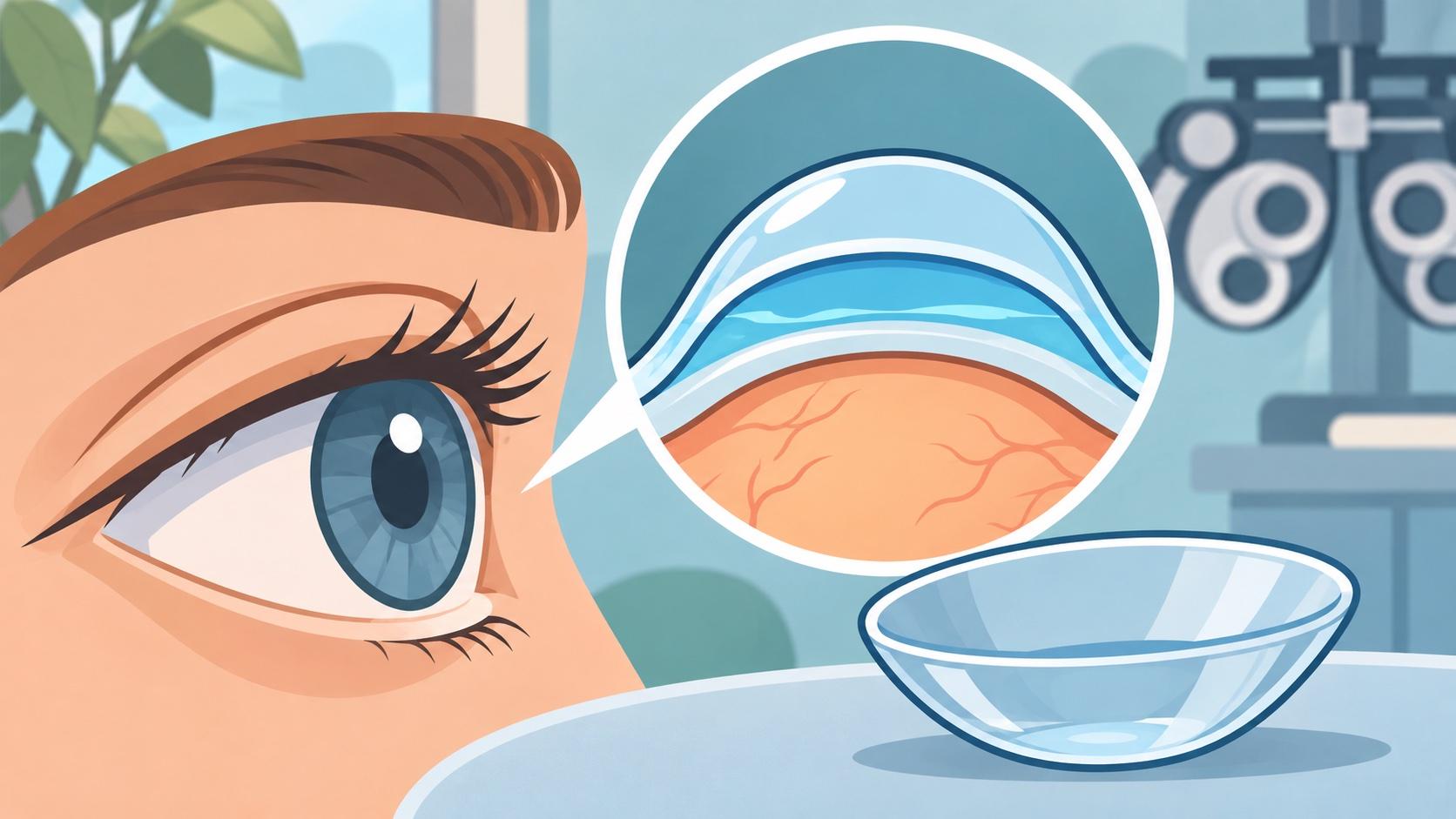
A scleral lens is a large, rigid, gas permeable contact lens. Instead of sitting on the clear dome at the front of your eye (the cornea), it arches over it and lands on the white part of the eye (the sclera).
They're noticeably bigger than regular contacts. Scleral lenses range from about 14 mm to more than 20 mm across(opens in new tab), compared with around 14 mm for a typical soft lens. They're fit to clear the cornea completely, leaving a small space under the lens that holds fluid. Before you put one in, you fill that space with preservative-free saline.
That saline layer does two things:
-
It fills in the gaps over an uneven cornea, so light passes through a smooth surface. This is why vision can improve so much for people with an irregular cornea.
-
It keeps the cornea bathed in moisture the whole time the lens is in, which is a big help for dry eyes.
What are scleral lenses used for?
Scleral lenses aren't an upgrade for everyone. They're for eyes that standard lenses can't correct well or keep comfortable. In an international survey of scleral lens fitters (the SCOPE study)(opens in new tab), 74% of scleral lens fittings were for an irregular cornea, 16% for disease of the eye's surface, and 10% for everyday nearsightedness, farsightedness, or astigmatism with no other eye problem (uncomplicated refractive error).
Keratoconus and other irregular corneas
Sometimes the cornea gradually thins and bulges forward into a cone shape, a condition called keratoconus. Glasses and soft lenses can't smooth out that uneven surface, so vision gets harder to correct as it progresses. Scleral lenses are one of the most effective non-surgical ways to get clear vision back. A systematic review of scleral lenses for keratoconus(opens in new tab) found they give lasting improvements in both vision and quality of life, especially in more advanced cases.
Corneal scars from an injury or infection can distort vision in a similar way, and scleral lenses can help there too. Our guide to keratoconus contact lenses in Ontario goes through all the lens options for keratoconus.
Contact lenses after LASIK or a corneal transplant
Most people who have LASIK never need contacts again. A small number are left with an uneven cornea afterwards, which shows up as blur, glare, halos, or double images that glasses can't fix. The same thing can happen after a corneal transplant or older vision-correction surgeries like radial keratotomy (RK).
Because a scleral lens vaults over the cornea instead of resting on it, the new shape of the eye matters much less. We cover this in more detail in irregular astigmatism after eye surgery.
Severe dry eye
For people with severe dry eye, the saline layer under a scleral lens works like a moisture chamber that lasts all day. This includes dry eye linked to Sjögren's syndrome (an autoimmune condition that dries out the eyes and mouth), or graft-versus-host disease after a stem cell transplant. In a study of 31 patients with graft-versus-host disease(opens in new tab), scleral lenses improved vision, dry eye symptoms, and the health of the eye's surface for most patients.
Scleral lenses usually come after drops and other treatments, not before. See scleral lenses for severe dry eye for more on how they're used, or our dry eye clinic if you haven't had your dry eye assessed yet.
When other contacts haven't worked
Some people don't have a named condition. They just never got on with contacts. Vision with soft lenses was still blurry because their cornea is curved more like a football than a basketball (astigmatism), or smaller rigid lenses were too uncomfortable to wear all day. If that sounds like you, scleral lenses are worth trying before you give up on contacts altogether.
How scleral lenses differ from regular contacts
Soft lenses drape over the cornea and take on its shape. If the cornea is uneven, the lens is uneven too, and your vision stays blurry.
Regular rigid gas permeable (RGP) lenses are smaller and sit directly on the cornea. They hold their shape, so vision is sharp, but they move with every blink. On a sensitive or cone-shaped cornea, that movement can be uncomfortable, and the lens can pop out.
Scleral lenses keep the sharp vision of a rigid lens but don't touch the cornea at all. They rest on the sclera and stay put when you blink.
Are scleral lenses uncomfortable?
Most people expect them to be, because of the size. In practice, most of our patients find them more comfortable than smaller rigid lenses once they're used to them. The cornea is one of the most sensitive parts of the body, and the sclera isn't. The part people find hardest is learning to put the lens in, not wearing it.
For a side-by-side comparison of the three types, see RGP vs. soft vs. scleral lenses.
What a scleral lens fitting involves
Every scleral lens is made to fit one eye, so the fitting takes more time than an ordinary contact lens exam. Plan on a few visits over several weeks.
A fitting usually includes:
-
A detailed map of the shape of your cornea (corneal topography) and a check of your tear film and eye health
-
Trial lenses to see how much space sits over the cornea and how the edge lands on the white of the eye
-
Adjustments to the lens curve, size, and edge until the fit is right
-
Ordering your custom lenses once everything is settled
-
Follow-up visits after you've worn them for a while, since lenses can settle slightly over the first few hours of wear
It's more work up front. The result is a lens made for the shape of your eye.
Daily life with scleral lenses
How to put in scleral contact lenses
This is the part that takes practice. You fill the bowl of the lens with preservative-free saline, tilt your head so you're looking straight down at a mirror or table, and place the lens on your eye with your fingers or a small suction tool (a plunger). The saline has to stay in the lens, so the aim is to get it on without trapping an air bubble. Removal is also usually done with a plunger.
Your optometrist will teach you this at the fitting and won't send you home until you can do it on your own. Most people get the hang of it within a couple of weeks.
How long can you wear scleral lenses in a day?
Most people wear scleral lenses through their waking day and take them out before bed. They aren't meant for sleeping in.
Some people find their vision gets a little hazy later in the day. This is called midday fogging, and it happens when debris builds up in the saline under the lens. Taking the lens out, rinsing it, and refilling it with fresh saline usually clears it up. If it happens a lot, a change to the fit or the solution often helps.
How long do scleral lenses last?
With good care, a pair commonly lasts around a year or two. Deposits, scratches, or a change in your prescription or eye shape can mean you need new lenses sooner. Cleaning follows a different routine from soft lenses. You'll use a cleaner made for rigid lenses and fresh preservative-free saline each time you put the lenses in. How to care for and clean specialty contact lenses walks through the routine.
Downsides to know about
Scleral lenses aren't perfect, and it's better to know that going in. Putting them in and taking them out takes more practice than soft lenses. Getting the fit right takes several visits, and now and then a lens has to be reordered. They cost more than standard contacts, because each lens is custom-made. And some wearers have to take a lens out and refill it partway through the day because of fogging.
For most of the people who need them, those trade-offs are worth it. When the alternative is blurry vision or eyes that burn all day, a few weeks of practice doesn't feel like much.
Cost and insurance
What you pay depends on whether one or both eyes need lenses and on how complex your eyes are. Many private extended health plans cover part of the cost of contact lenses, and some cover more when the lenses are medically necessary, such as for keratoconus. OHIP doesn't pay for contact lenses, so check your plan's benefits before your fitting. For a full breakdown, see how much scleral lenses cost in Ontario.
Is it worth finding out?
Some of the most satisfying visits we have are with people who'd given up on contacts years ago. They were told their prescription was "too complicated," or their eyes were too dry, or they'd put up with blurry glasses since a surgery. If any of that sounds familiar, a scleral lens consultation will tell you whether they're an option for your eyes. At Elevate Vision Care in Markham, we'll map your cornea, check your eye's surface, and talk through what you've already tried. Submit an inquiry(opens in new tab) to book a scleral lens consultation.