Keratoconus Contact Lenses: Treatment Options in Ontario

Dr. Jason Huang
·11 min read
Opens our inquiry form in a new tab. Tell us what's going on and the clinic will follow up about a consultation.
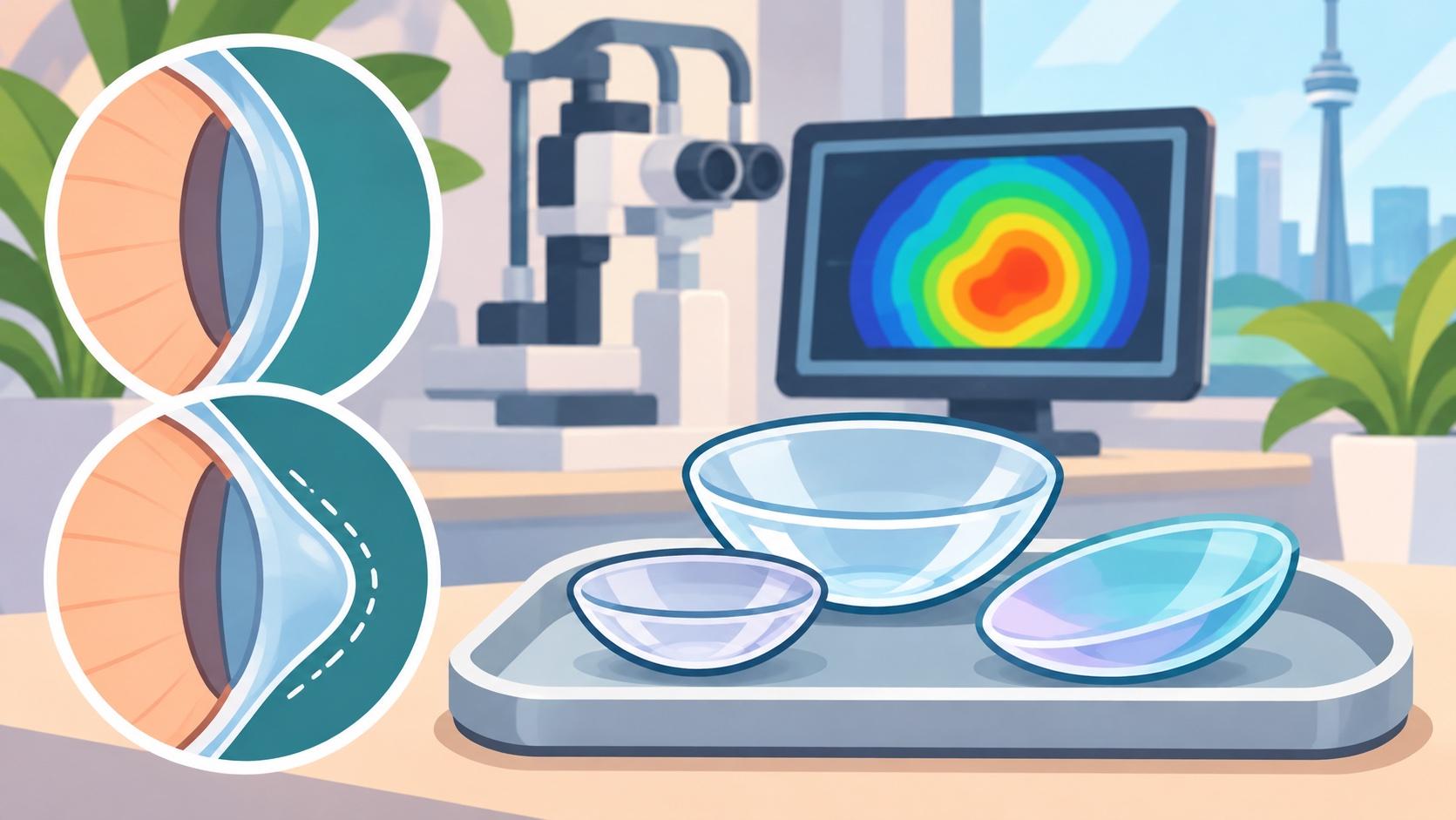
If you’ve recently been diagnosed with keratoconus, you may be hearing the term for the first time and have a lot of questions about what it means. The short version: the clear front surface of your eye (the cornea) has started to thin and bulge forward into a cone shape instead of staying evenly round. That uneven shape bends light in unpredictable ways, which explains why your glasses stopped working as well as they used to, why your prescription seems to change at every visit, and why keratoconus contact lenses end up being the answer for most people.
It's also more common than people assume. A nationwide study of 4.4 million insured patients in the Netherlands(opens in new tab), published in the American Journal of Ophthalmology, estimated that about 1 in 375 people has keratoconus, 5 to 10 times higher than older estimates. In that study, the average age at diagnosis was in the late twenties.
Here's the part I most want newly diagnosed patients to hear: keratoconus is very manageable. For most people, the right keratoconus contact lenses bring back clear, everyday vision, and the rest of this post explains how, along with where cross-linking and OHIP fit in.
What Keratoconus Does to Your Vision
A healthy cornea is shaped a bit like the smooth dome of a watch face. With keratoconus, the collagen fibres that hold that dome together weaken, and the cornea gradually steepens and thins, usually a little below the centre.
Early on, you might notice:
-
Blurry or slightly doubled vision, especially at night
-
Halos, streaks, or "ghost images" around lights and letters
-
More sensitivity to glare
-
Prescriptions that change more often than they should, particularly the astigmatism
Keratoconus usually affects both eyes, but rarely equally. It's common for one eye to be noticeably worse than the other.
We don't know exactly what causes it. Genetics, allergies, and eye rubbing all seem to play a part. A 2021 meta-analysis in Graefe's Archive for Clinical and Experimental Ophthalmology(opens in new tab) found that people with keratoconus were several times more likely to report frequent eye rubbing, though the authors note the studies can't prove that rubbing causes it.
Even so, avoiding eye rubbing is one of the most protective habits after a diagnosis, and it's something your optometrist will almost certainly bring up. If itchy, allergic eyes are what makes you rub, mention it, since the itch itself can usually be treated.
Why Glasses Stop Being Enough for Keratoconus
In mild keratoconus, glasses often still do a decent job. The problem comes as the cornea gets more irregular.
Glasses are designed for eyes that are curved more in one direction than the other in a neat, predictable pattern (called regular astigmatism). Keratoconus warps the surface unevenly, more like a slightly crumpled sheet of plastic than a rugby ball, which is known as irregular astigmatism.
No spectacle lens can be ground to match that. You end up with glasses that make things clearer but never quite clear.
A rigid contact lens gets around this in a clever way. Instead of trying to match the bumpy cornea, it sits in front of it and gives your eye a brand-new, perfectly smooth front surface. Your tears fill the space between the lens and the irregular cornea, and most of the distortion disappears. That's why contacts, rather than glasses, are the backbone of keratoconus care, and why regular soft lenses often fall short for the same reason glasses do. (Our overview of specialty contact lenses for when regular contacts don't work covers this in more depth.)
Many of our keratoconus patients still keep a pair of glasses for early mornings, late evenings, or days when their eyes need a break.
Keratoconus Contact Lens Options
There's no single "keratoconus lens." The right choice depends on how advanced the condition is, where the cone sits on your cornea, and how your eyes tolerate different materials.
Rigid gas permeable (RGP) lenses. These small, firm lenses sit on the cornea itself and are the traditional first choice. In the landmark Collaborative Longitudinal Evaluation of Keratoconus (CLEK) Study(opens in new tab), which followed 1,209 patients, 65% wore RGP lenses at the start of the study, and most of them (73%) said their lenses were comfortable. RGPs give very sharp vision, but they take some getting used to, and they can become harder to keep centred as the cone steepens.
Scleral lenses. These are much larger rigid lenses that vault completely over the cornea and rest on the white of the eye (the sclera). Because they never touch the cone, they tend to stay stable and comfortable even when the cornea is very irregular. The lens is filled with sterile saline before it goes in, so the cornea sits in a cushion of fluid all day.
A 2025 systematic review(opens in new tab) of scleral lens studies in keratoconus found consistent, substantial improvements in best-corrected vision and in patients' vision-related quality of life. The downsides that came up were mostly practical: learning to put the lenses in and take them out, and the lens fogging up partway through the day. Our Scleral Lenses 101 guide explains how they work day to day.
Hybrid lenses. A hybrid lens has a rigid centre for crisp optics, surrounded by a soft outer skirt for comfort. It's a good middle ground for people who like the vision from an RGP but can't settle into the feel of one.
Piggyback lenses. Occasionally we place a soft lens underneath an RGP, like a cushion. It's less common now that scleral and hybrid designs have improved, but it can still be a useful fix for comfort.
Here's how the main options compare:
RGP | Hybrid | Scleral | |
|---|---|---|---|
Size | Small (sits on the cornea) | Medium (rigid centre, soft skirt) | Large (rests on the sclera) |
Typically used for | Mild to moderate keratoconus | Mild to moderate keratoconus when RGP comfort is a problem | Moderate to advanced keratoconus, or when smaller lenses won't stay put |
Vision quality | Very sharp | Very sharp | Very sharp |
Initial comfort | Takes adaptation | Good | Usually good once handling is learned |
Handling | Easy | Moderate | Takes practice (plunger or fingertip technique) |
Fitting visits | Fewer | Moderate | More, since each lens is custom-built |
If you'd like a deeper side-by-side, we've written a full comparison of RGP, soft, and scleral lenses.
What a Keratoconus Contact Lens Fitting Involves
Fitting keratoconus contact lenses isn't like picking up a box of soft lenses. It usually takes a few visits.
-
Mapping the cornea. We take a detailed map of your cornea's shape (called corneal topography) and measure how thick the cornea is (called pachymetry). These show how steep the cone is, where it sits, and how much the cornea has thinned. Both are part of a comprehensive eye exam for anyone with suspected keratoconus.
-
Trial lenses. Based on the maps, we place diagnostic lenses on your eyes and check how they sit with a microscope and a special dye (or, for scleral lenses, by checking the clearance over the cornea).
-
Ordering custom lenses. Keratoconus lenses are made to order for each eye.
-
Training and follow-ups. You'll learn how to insert, remove, and clean your lenses, and we'll fine-tune the fit over the following weeks. Rigid lenses need their own care routine, which we cover in our guide to cleaning and caring for specialty contact lenses.
Don't be discouraged if your first lens isn't perfect. Most fits get tweaked at least once, and I'd much rather adjust a lens a couple of times than have you settle for one that's just okay.
Corneal Cross-Linking: Stabilizing the Cornea
Contact lenses change how you see, but they do nothing to stop the cornea from continuing to steepen. Corneal cross-linking is the treatment aimed at that second problem.
Cross-linking is a procedure, performed by an ophthalmologist, that uses riboflavin (vitamin B2) eye drops and ultraviolet light to create new bonds between the collagen fibres of the cornea, making it stiffer. The goal is to slow or stop the cone from getting steeper.
It has good trial evidence behind it. A randomized controlled trial with three years of follow-up(opens in new tab), published in Ophthalmology, found that treated eyes held their improvement over the full three years, while untreated eyes kept getting steeper. A U.S. multicentre randomized trial(opens in new tab) reported a similar pattern after one year.
Cross-linking and contact lenses aren't competing choices. Many patients have both: cross-linking to stabilize the cornea, and custom lenses for clear vision afterward. Timing matters most for younger patients. A meta-analysis of more than 11,000 untreated eyes(opens in new tab) found that younger patients showed more steepening over a year, which is why teens and young adults with keratoconus are monitored closely.
If your measurements show the keratoconus is progressing, your optometrist can refer you to an ophthalmologist to discuss whether cross-linking makes sense for you.
Keratoconus Treatment in Ontario: What OHIP Covers
We get asked this constantly. Coverage depends on which part of the care you mean:
-
Eye exams. Children 19 and under and adults 65 and over already have OHIP-covered eye exams. Adults 20 to 64 are covered only if they have an eligible medical condition. Ontario's list of those conditions(opens in new tab) includes "corneal disease that is acute, or is chronically progressive," and qualifying patients get one major eye exam every 12 months plus two follow-up assessments. Keratoconus can qualify, depending on your situation. Our guide to OHIP eye exam coverage in Ontario explains the rules in more detail.
-
Contact lenses. OHIP doesn't cover contact lenses, including keratoconus lenses.
-
Cross-linking. According to the Eye Physicians and Surgeons of Ontario(opens in new tab), cross-linking has been an uninsured service in Ontario, though some patients may be able to get it at no cost through academic eye centres. Funding rules change, so ask your ophthalmologist what applies when you're referred.
What Keratoconus Contact Lenses Cost
Because keratoconus lenses are custom-made, there isn't one flat price. The total usually depends on:
-
The professional fitting fee (the mapping, trial lenses, and follow-up visits)
-
The lens type (scleral lenses generally cost the most, RGPs the least)
-
Whether one or both eyes need fitting
-
How often the lenses need replacing, which varies by lens and by how much your eyes change
Most extended health plans include a vision or contact lens allowance, and some provide more coverage when lenses are medically necessary, which keratoconus often qualifies as. It's worth calling your insurer before your fitting to ask. For more on how pricing works, see our breakdown of scleral lens costs in Ontario.
Living With Keratoconus
A keratoconus diagnosis doesn't mean your vision is on an inevitable slide. According to the American Academy of Ophthalmology(opens in new tab), it often starts in the late teens or early twenties, and the vision changes usually creep along slowly over about 10 to 20 years. With well-fitted lenses and regular check-ups, most people drive, study, work on screens, and play sports with clear vision.
The habits that tend to matter most are simple ones. Avoiding eye rubbing, and getting itchy allergies treated so the urge isn't there, helps protect the cornea. Regular monitoring matters too, often every 6 to 12 months, or more often if the cornea is changing.
If your lenses start to feel different or you are seeing differently, let your optometrist know, because that can mean the cornea has changed and the fit needs an update. If you've been curious about laser surgery, LASIK is generally not recommended for keratoconus. It works by removing corneal tissue that a thin, irregular cornea can't spare, so ask your optometrist about alternatives instead.
Taking the Next Step
If you've been diagnosed with keratoconus, or your prescription keeps changing and nobody has explained why, a detailed corneal assessment is the place to start. We'll map your corneas, look at whether anything is progressing, and walk you through the lens options that suit your eyes and your day. Submit an inquiry(opens in new tab) and our team will be in touch to set up your keratoconus consultation.