What to Expect During Vision Therapy Sessions (And Does It Really Work?)

Dr. Melissa Yeung
·8 min read
Does vision therapy actually work? Fair question before committing five to eight months to a program. Short answer: yes, for the binocular vision problems it's designed to treat. The largest randomized trial we have, the Convergence Insufficiency Treatment Trial(opens in new tab), found that about 73% of children with convergence insufficiency improved significantly with office-based therapy. Home-only and placebo groups did much worse.
If you've completed your binocular vision assessment and vision therapy has been recommended, this post covers what actually happens in sessions, what you'll do at home, how long the whole thing takes, and what the research says about outcomes.
Before the first session
Bring your glasses if you wear them, a snack for afterward (sessions can be mentally tiring), and comfortable clothing since we sometimes do activities involving balance or movement.
For kids: explain it as "activities to help your eyes work better together, kind of like exercise for your eyes." On our end, we try to include exercises that are fun and engaging, so sessions don't feel like a chore.
The first session
When you arrive, the vision therapist working with you under my supervision will introduce themselves and spend a few minutes getting to know you: your interests, your goals, what you're hoping will change. Vision therapy takes effort, and patients work harder when they feel connected to their therapist.
From there you'll start on actual activities, and the therapist will explain what each one targets and why. We want you to understand the purpose behind every exercise, not just follow instructions.
We finish by reviewing what was covered, introducing your first home exercises, answering questions, and scheduling upcoming sessions.
What a typical session looks like
After the first session, appointments follow a consistent structure:
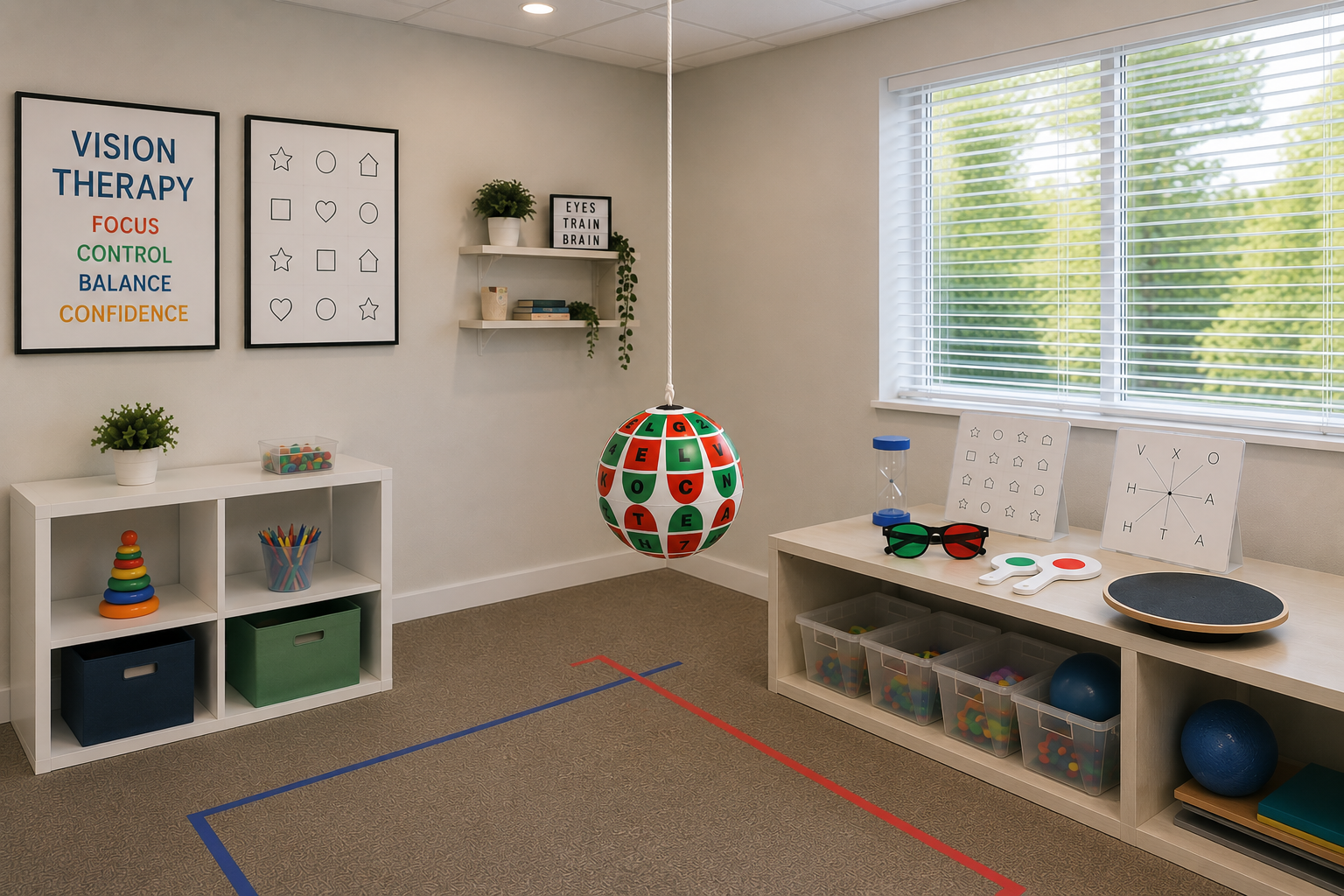
Targeted exercises — Aimed at your specific visual weaknesses. Depending on what we're working on, that might be computer-based programs (software built for training visual skills, engaging but not video games), lens and prism work (wearing special lenses while doing tasks that challenge the visual system), hand-eye coordination tasks like catching a ball, placing pegs, or tracing patterns, and 3D and depth perception exercises. Activities progress as skills develop. What was challenging in week one becomes easier, and we introduce harder variations.
Home exercise review — We check how home practice went, troubleshoot problems, and teach new exercises for the coming week.
About home exercises
Home therapy reinforces what you learn in the office. Without it, progress slows and treatment takes longer.
Expect 15-20 minutes of exercises, 5 days per week. Activities can be done at a table or on the floor. We'll provide or recommend simple equipment, and you'll get clear instructions, both written and demonstrated.
Pick a consistent time each day. Create a space free from distractions. Track completion so we can discuss adherence at sessions.
For parents: Be present but don't take over. Let your child do the work. If exercises become a battle, tell us immediately. We can adjust activities, simplify the routine, or troubleshoot. Forcing compliance creates negative associations that undermine the whole process.
For adults: Treat home exercises like physical therapy. They're part of the treatment, not optional extras. Adults often do better tying the routine to existing habits, morning or evening.
What to know about the process
The closest comparison is training at a gym with a coach. Your weekly session is where you learn the movement and where we adjust the load. The work you do between sessions is what actually builds the strength.
Sessions are mentally demanding. Even if activities look simple, the brain is working hard, the same way a light weight is hard when the form is right. Don't be surprised by fatigue afterward. That's normal. It means the visual system is being challenged.
Progress isn't always linear. Some weeks feel like breakthroughs and others feel flat. Plateaus happen in the gym too, and they don't mean the training stopped working. The brain needs time to consolidate what it's working on before the next gain shows up.
Attendance matters. Consistent weekly sessions build on each other. Missing appointments disrupts momentum. If you need to reschedule, let us know as soon as possible.
Tell us what you're noticing along the way. If reading at work is suddenly easier, we want to know. If a particular exercise feels off or you've hit a wall, that's useful information too. We adjust based on what you tell us.
For parents
If you're bringing your child to vision therapy: don't be surprised if they're tired after sessions. Watch for real-world improvements, like homework getting easier or less complaining about reading. If your child starts resisting exercises, let us know before it becomes a battle. Your role is to provide structure and support, not to become their therapist.
Signs of progress
Progress often shows up in daily life before formal re-testing confirms it.
For adults, this might look like reading longer without fatigue, work tasks taking less effort, fewer headaches, better focus, less avoidance of near work, or eyes just feeling more comfortable.
For children: reading longer without complaints, homework taking less time, fewer headaches, better attention, improved coordination, more willingness to do close work, using both eyes together instead of closing one, better sports performance.
We also measure progress objectively at regular intervals using standardized tests. You'll see the numbers improve alongside the real-world changes.
Common questions
"The exercises feel too easy/hard." Good feedback. Tell us. We calibrate difficulty based on individual abilities. If something is too easy, it's not training anything. If it's too hard, frustration sets in. The sweet spot is "challenging but achievable."
"How will I know it's working?" We measure progress objectively at regular intervals. You'll also notice changes in daily life.
"What if I miss a session?" Life happens. Let us know as soon as possible so we can reschedule. Occasional misses won't derail the program.
"Can I do extra home exercises to speed things up?" More isn't always better. The visual system needs rest to consolidate new skills. Stick to what's prescribed unless we recommend otherwise.
"What if progress stalls?" Plateaus happen. If progress stalls for several weeks, we reassess. Sometimes we need to adjust the approach, change difficulty, or address a different skill first.
Program completion
Vision therapy doesn't go on forever. Most programs take 5-8 months. (See our detailed breakdown of vision therapy costs for what to expect financially.)
As you master the targeted skills, we conduct final testing to document improvement, compare results to your baseline, discuss maintenance activities to retain gains, and schedule follow-up appointments as needed, typically at 3 and 6 months.
Graduation means you've developed the visual skills that were lacking. These skills, once established, typically remain. Periodic "tune-ups" may help during times of stress or increased visual demands, but ongoing treatment isn't usually necessary.
A note on expectations
Vision therapy isn't a quick fix. Most programs take 5-8 months and require consistent work both in-office and at home.
If it helps, think of it like getting a tutor. Nobody expects OHIP to cover tutoring, and families sign up anyway because they can see the difference it makes in how their kid handles school. Vision therapy is a similar sort of decision. OHIP doesn't cover the sessions either, though it's worth checking your private plan. And the payoff is the same kind of thing: reading and focusing stop taking so much effort, so everything that depends on them gets easier.
The nice part is that vision therapy ends. Once those visual skills are in place, they tend to stick around, and you're done coming in.
It does work, though. The Convergence Insufficiency Treatment Trial(opens in new tab) showed that 73% of children with convergence insufficiency improved significantly with office-based vision therapy, and we see similar patterns in clinic.
What that looks like is hard to predict in advance, but the changes tend to be the kind people actually notice. A kid who used to dread reading starts picking up books on their own. Homework that used to take three hours gets done in one. Persistent headaches finally lift. An adult who'd been avoiding long stretches of screen work realizes they can sit through a workday without their eyes giving out.
Still deciding whether to start? Our vision therapy quiz asks 11 quick questions about the symptoms that most often point to an eye teaming or focusing problem. It takes about two minutes and no email is required.
Ready to get started?
If you're considering vision therapy or have questions, submit an inquiry(opens in new tab) and our team will be in touch.