Binocular Vision Dysfunction Test: What to Expect at Your BVD Assessment

Dr. Melissa Yeung
·8 min read
You've noticed something isn't quite right with your vision, or your child's. Maybe reading is exhausting. Headaches are constant. You lose your place on the page over and over. Focusing at work has become a grind, or a teacher keeps mentioning attention issues. Something feels harder than it should be.
The first step is a binocular vision test, sometimes called a binocular vision dysfunction (BVD) test or a functional vision assessment. It's not a routine eye exam. It's a longer, more thorough look at how the whole visual system actually functions, not just whether you can read the letters on a chart.
Here's what actually happens during the appointment, whether you're coming in yourself or bringing your child.
How a binocular vision test differs from a regular eye exam
A standard eye exam answers two main questions: Is eye health normal? Are glasses needed?
A binocular vision test goes further. (Some optometrists call it a functional vision exam, same thing under a different label.) It looks at whether the eyes actually work together as a team. Do they track a moving object smoothly? Can they shift focus from your phone to the back of the room without lag? It also looks at how the brain processes what the eyes see, and how vision lines up with how you move your body.
Plenty of people with 20/20 eyesight have functional vision problems that affect reading or coordination. These don't show up on a standard eye chart, but they can make daily life harder than it needs to be.
Before the Assessment
Bring your current glasses if you wear them, any previous eye exam records, and a list of symptoms or concerns you've noticed. For children, school reports or teacher feedback about visual concerns can be helpful.
Schedule when you're typically alert. Not after a long workday or, for children, right after school when they're tired. Make sure you've eaten; low blood sugar affects concentration and test performance. And know that this isn't a pass/fail test. There are no wrong answers.
For kids specifically: explain that we'll be doing "activities to see how your eyes work together." Reassure them there are no wrong answers. Don't coach them on how to "do well," because we need to see how their visual system actually functions, not how it performs under pressure.
Arriving at the Clinic
When you arrive, our team will welcome you. We'll confirm completion of paperwork.
The paperwork you completed beforehand helps me understand:
What prompted you to seek this assessment
Specific symptoms or concerns
How these issues affect daily life, work, or learning
Reading habits and near-work demands
Any previous diagnoses or interventions
For children, I'll speak directly with them to understand their perspective.
This part isn't filler. It tells me what to focus on during testing and how to read what comes up.
The Assessment: What We Test
The evaluation includes several different tests. Here's what happens:
Visual processing tests — Depending on symptoms, we may test visual-motor integration (copying shapes), visual memory, visual discrimination (noticing differences between similar images), and spatial awareness. These skills affect reading, writing, and any task requiring visual-spatial processing.
Primitive reflex screening — Primitive reflexes are the automatic movement patterns babies are born with, and they normally fade as the nervous system matures. When they stick around, they can interfere with posture, balance, and the eye movements reading depends on. Screening for retained reflexes sometimes explains why visual skills haven't developed the way they should.
Refraction — We check whether glasses are needed, or whether an existing prescription is still accurate.
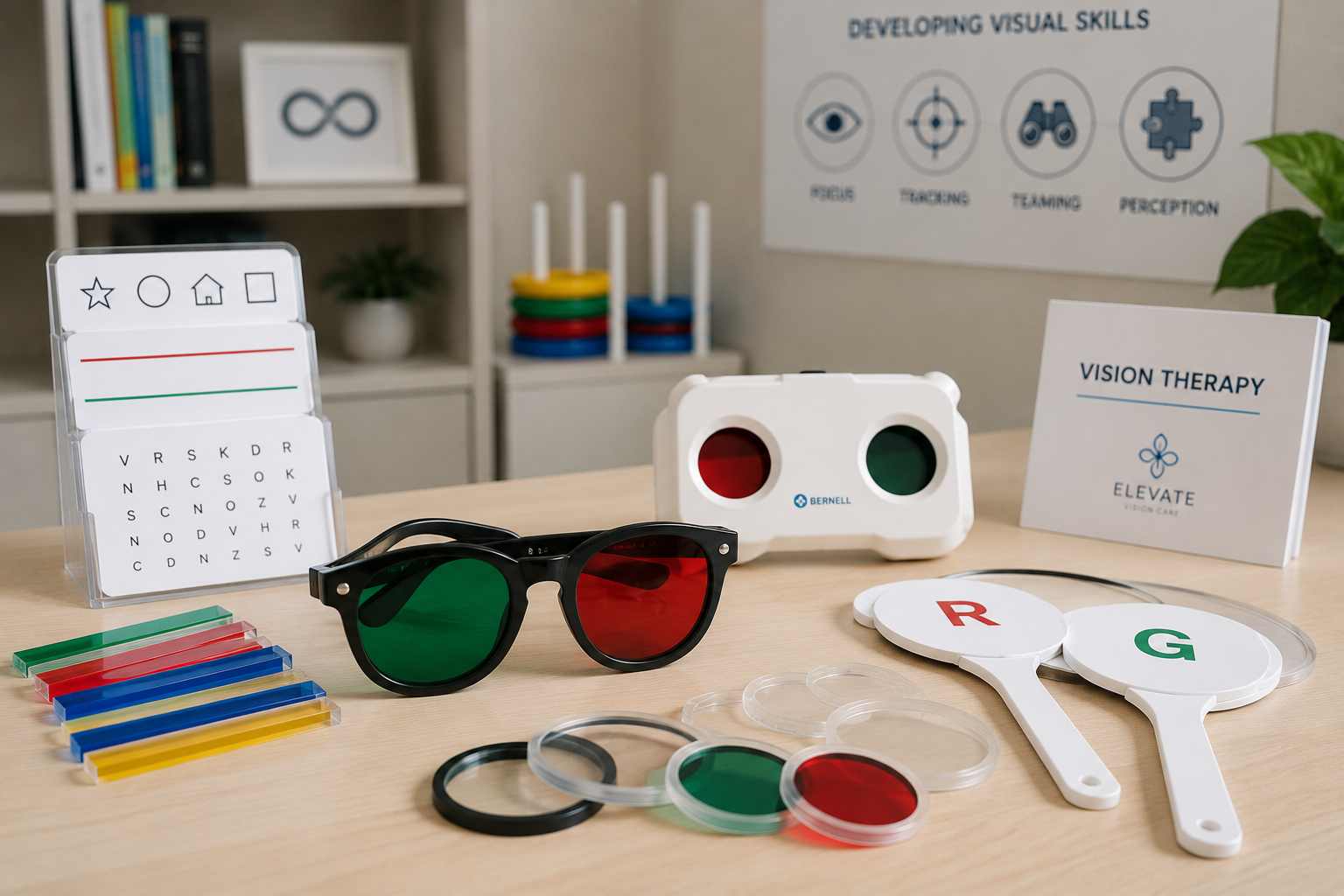
Eye teaming tests — These evaluate how well both eyes work together. Can they turn inward to focus on near objects? Relax outward for distance? Can the brain combine images from both eyes into one clear picture? You might look at targets through special lenses, follow objects as they move closer, or view 3D images.
Eye movement tests — We assess pursuits (smoothly following a moving object, like tracking a ball) and saccades (quickly jumping between targets, like moving from word to word while reading). Poor eye movements often explain why someone loses their place while reading.
Focusing tests — Can the eyes focus precisely at different distances? Shift focus quickly between near and far? Maintain focus during sustained close work? Problems here often cause blurry vision, headaches, or fatigue during reading.
For Parents: During Your Child's Assessment
We ask parents to wait in the reception area rather than sit in on the testing. This isn't about keeping you out of the loop. Children tend to look to a parent for reassurance or cues, and that changes how they perform. I need to see how your child's visual system works on its own, without that safety net.
You'll get the full picture right after. We sit down together to go through what I found, what it means, and the specific moments during testing that stood out.
After the Testing: Understanding the Results
Once testing is complete, we sit down together to discuss findings. I'll walk through which visual skills are strong, which are weak or underdeveloped, and how these findings explain what you've been experiencing.
Then we talk about what it means practically: how these issues affect reading or learning, why other interventions may not have worked, and what we'd recommend. Whether that's vision therapy, glasses, or something else entirely.
If Vision Therapy Is Recommended
If the assessment reveals functional vision problems that would benefit from treatment, I'll outline what a vision therapy program would look like: the specific visual skills we'd work on, how often you'd come in, a realistic timeframe for improvement, and how we'd measure progress. I'll also go over costs and payment options. (See our detailed breakdown of vision therapy costs in Ontario for specifics.)
You don't need to decide on the spot. A written report takes time to put together properly, so you'll receive yours after the appointment. Read it over, think it through, reach out with questions. This is a real commitment, and I'd rather you feel confident than rushed.
If Vision Therapy Isn't Recommended
Sometimes the assessment reveals that vision therapy isn't the right solution. Perhaps the issue is purely refractive (glasses will solve it), or perhaps the symptoms have a different cause. In these cases, I'll:
Explain why vision therapy wouldn't help
Recommend appropriate next steps
Refer to other specialists if needed
I'd rather tell you that than start a treatment program you don't actually need.
Common findings
A few conditions come up often:
Convergence insufficiency (the most common finding)
The most frequently diagnosed functional vision problem is convergence insufficiency. The eyes struggle to turn inward for close-up work like reading, which often shows up as headaches, double vision, or words that seem to drift on the page. Some kids just stop reading altogether rather than push through it.
The convergence insufficiency test is a specific part of the binocular vision exam, measuring how close to your nose your eyes can comfortably converge (the "near point of convergence") and how well that convergence holds up under sustained effort.
Other common findings
Accommodative dysfunction means the eyes can't focus accurately or hold focus. Blurry vision, fatigue during reading, trouble copying from the board.
Tracking deficits show up as losing your place while reading, skipping words or lines, needing a finger to keep track. The eyes aren't jumping smoothly between targets.
Binocular vision dysfunction is a broader term for when the eyes just don't work together well. Double vision, closing one eye to compensate, poor depth perception, general clumsiness.
A note on ADHD: parents of children with ADHD sometimes book a binocular vision test because attention struggles overlap with symptoms of convergence insufficiency and tracking problems. Vision therapy isn't a treatment for ADHD, but identifying an underlying visual issue can make reading and focused work measurably less effortful.
Questions to ask
Before you leave, make sure you understand what specific vision problems are present and how they're affecting daily life. Is vision therapy recommended, and why or why not? If so, what would treatment involve, and what outcomes are realistic? Are there other options worth considering?
Write these down beforehand if it helps. I'd rather answer too many questions than have you leave unsure.
Taking the first step
If you're struggling, or your child is, and you suspect vision might be part of the picture, a comprehensive assessment is the best way to find out what's actually going on. Even if vision therapy isn't the answer, you'll walk out with real information instead of guesses.
A common assumption with adults is that whatever vision issues you have are just permanent. They're usually not. Functional vision can be trained at most ages, whether you've struggled since you were a kid or only started noticing problems later in life.
With children, earlier usually means faster progress. If your kid is showing signs of visual struggle, getting answers before school demands ramp up gives you more room to work with.
If vision therapy is recommended after your assessment, read our guide on what to expect during vision therapy sessions to understand what the treatment process actually looks like.
Not sure whether an assessment is the right next step? Our vision therapy quiz asks 11 quick questions about reading, headaches, and focus, then tells you whether it is worth raising with us. It takes about two minutes and no email is required.
Ready to book?
Submit an inquiry(opens in new tab) and our team will be in touch to schedule your assessment.