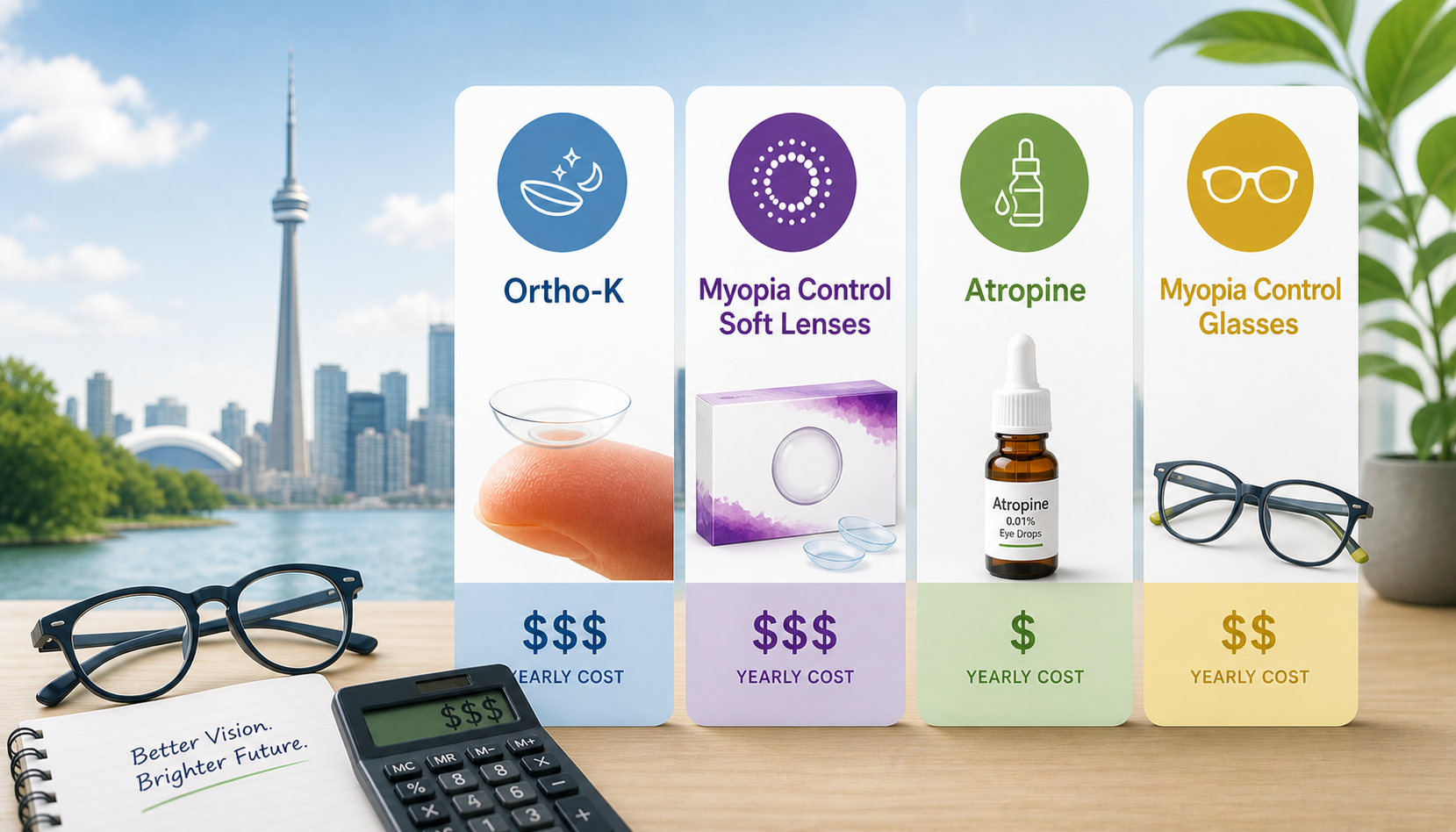
How Much Does Myopia Control Cost in Ontario? Ortho-K, MiSight & Atropine Compared

Dr. Jason Huang
·10 min read
If your myopia is getting worse every year, or you're watching the same thing happen to your child, you've probably heard about myopia control treatments. Ortho-K. MiSight. Myopia control glasses. Atropine drops. These are proven ways to slow myopia progression, but one thing most clinics don't tell you upfront: how much does this actually cost?
Most clinics don't publish their myopia control lens prices in Canada, so I will. Here's what these treatments actually cost in Ontario, what's included, and how to make it more manageable.
The Quick Comparison
Treatment | First Year Cost | Annual Cost (Year 2+) | What's Included |
Ortho-K | $2200-$2700 | $900-$1500 | Custom lenses, fitting, Doctor follow-ups, Cleaning solutions(year 1) |
Myopia control soft contact lenses (MiSight, Abiliti 1-Day) | $1300-$2000 | $1300-$1900 | Daily lenses, fitting, Doctor follow-ups |
Myopia control glasses (MiYOSMART, Stellest, MyoCare, others) | $850-$1700 | $750-$1300 | Frames, specialty lenses, Doctor follow-ups |
Low-dose atropine | $1000-$1800 | $1000-$1800 | Compounded drops, Doctor follow-ups |
Combination therapy | $1600-$3900 | $1500-$2700 | Atropine + glasses or soft lenses or OrthoK |
Costs vary by clinic, region, and individual treatment needs. Ranges reflect typical Ontario pricing at the time of writing.
Now let's break down what each treatment involves and why the costs vary.
How Much Do Ortho-K Lenses Cost?
Ortho-K, or orthokeratology, uses custom-designed rigid contact lenses worn overnight to reshape the cornea. You wake up with clear vision—no glasses or contacts needed during the day.
First Year Ortho-K Lenses Cost: $2200-$2700
The higher first-year cost reflects the complexity of fitting:
Component | Cost Range |
|---|---|
Comprehensive myopia assessment | $150-$250 |
Corneal topography mapping | Included or $200-$300 |
Custom Ortho-K lens fitting and training | $1,400-$1,600 |
Follow-up visits (6-8 in first year) | $350-$450 |
Starter lens care Cleaning kit | $90-$180 |
Why do orthokeratology lenses cost more?
Lenses are custom-manufactured using precise corneal measurements
Fitting requires advanced training and equipment
Multiple follow-up visits ensure optimal results and safety
Multiple Trial lenses may be needed to achieve the best fit
Ongoing Annual Costs: $900-$1500
Component | Cost Range |
|---|---|
Replacement lenses (annual) | $500-$800 |
Monitoring visits (3-4/year) | $300-$500 |
Lens care solutions | $90-$180 |
Who it's best for:
Anyone who wants to be glasses-free during the day
Active individuals involved in sports, swimming, or dance
Patients with moderate myopia (-1.00 to -6.00 D)
Those committed to a nightly overnight ortho-k lenses routine
Children and teens with myopia (excellent for slowing progression)
If you're in the Greater Toronto area and want to learn more, we offer ortho-k fittings at our Markham clinic.
How Much Do Myopia Control Soft Contact Lenses Cost?
Myopia control soft contact lenses are daily disposable contacts with a specially engineered optical design that slows myopia progression while correcting vision. They're worn during the day and discarded each night — no cleaning, no overnight wear.
The most widely used brand is MiSight (CooperVision), which has been FDA-approved for myopia control in children since 2019. A newer option, Abiliti 1-Day (Johnson & Johnson), has also started appearing on the Canadian market.
Annual Myopia Control Soft Contact Lens Cost: $1300-$2000
Component | Cost Range |
|---|---|
Comprehensive myopia assessment | $150-$250 |
Lens fitting and training | $100-$200 |
Annual supply of lenses | $1000-$1300 |
Follow-up visits (2-3/year) | $100-$300 |
Why these lenses are more affordable than Ortho-K:
Lenses are mass-produced, not custom-made
Fitting is simpler than Ortho-K (similar to regular soft contact lenses)
Daily disposables eliminate cleaning routines and lens care costs
Ongoing annual cost:($1300-$1900)
Component | Cost Range |
|---|---|
Comprehensive myopia assessment | $150-$250 |
Lens fitting | $100-$170 |
Annual supply of lenses | $1000-$1300 |
Follow-up visits (2-3/year) | $100-$300 |
Unlike Ortho-K, costs stay fairly consistent year over year since you're purchasing a year's supply of lenses annually.
Who it's best for:
Those who prefer daytime lens wear over overnight lenses
Patients already comfortable with contact lenses
Anyone who wants a simpler daily routine (no overnight wear)
Children ages 8-12 starting myopia control (MiSight is Health Canada and FDA-approved for this age range)
Patients with lower myopia or those new to myopia control
How Much Do Myopia Control Glasses Cost?
Myopia control glasses are specially designed spectacle lenses that slow myopia progression while also correcting vision — no contact lenses and no drops. In Canada, the two most common options you'll hear about are MiYOSMART (made by Hoya, using D.I.M.S. or "Defocus Incorporated Multiple Segments" technology) and Stellest (made by Essilor, using H.A.L.T. or "Highly Aspherical Lenslet Target" technology).
Other myopia control spectacle products entering the Canadian market include MyoCare (Zeiss), MiSight spectacles (CooperVision), also known as SightGlass DOT lenses (Diffusion Optics Technology from SightGlass Vision). Availability and pricing vary by clinic and region.
First Year Myopia Control Glasses Cost: $850-$1700
Component | Cost Range |
Comprehensive myopia assessment | $150-$250 |
Specialty lenses (MiYOSMART or Stellest) | $500-$800 |
Frames | $100-$300+ |
Follow-up visits (2-3/year) | $100-$300 |
Ongoing annual costs: $750-$1300
Most of the ongoing cost is new lenses. Kids often need a fresh pair once a year as their prescription changes, though frames can usually be reused. Follow-up visits continue to be part of the program.
Why myopia control glasses cost more than regular glasses:
The lenses use engineered optical designs developed from years of clinical research
They aren't stocked locally — each pair is ordered and surfaced to prescription
Children in active myopia progression often need updated lenses annually
What the research shows:
MiYOSMART lenses slowed myopia progression by 52% and axial elongation by 62%(opens in new tab) over a 2-year randomized clinical trial published in the British Journal of Ophthalmology. Stellest lenses showed a 55% reduction in myopia progression(opens in new tab) — and up to 68% reduction when worn at least 12 hours daily — in a 2022 study published in JAMA Ophthalmology.
Who it's best for:
Children and teens who prefer glasses over contact lenses
Younger kids (as young as 6 or 7) not ready for contacts or drops
Families wanting the simplest daily routine (put them on, take them off)
Kids who can't tolerate contact lenses
Parents uncomfortable with overnight lens wear or daily medication
Important considerations:
The lenses must be worn consistently, ideally 12+ hours a day.
Kids who leave their glasses at home, take them off for sports, or resist wearing them get less benefit
Glasses can be lost or broken, so budget for potential replacements
Prescriptions usually change as children grow, so plan for yearly lens updates
Low-Dose Atropine Eye Drops
What it is: Very dilute atropine eye drops (typically 0.01%-0.05%) applied once daily at bedtime. Atropine slows the elongation of the eye that causes myopia progression.
Annual Cost: $1000-$1800
Component | Cost Range |
|---|---|
Comprehensive myopia assessment | $150-$250 |
Compounded atropine drops (12 months) | $780-$12000 |
Monitoring visits (2-3/year) | $100-$300 |
Why atropine is a good option:
Can be combined with other myopia control options
Administration is simple (one drop at bedtime)
Fewer office visits are required than lens-based treatments
Can be used alongside regular glasses or contact lenses
Important considerations:
Atropine must be compounded by a specialized pharmacy (not available at regular pharmacies)
Using Low dose Atropine in Canada is considered off label use for myopia control
You still need glasses or contacts for vision correction
Some patients experience mild side effects (light sensitivity, near blur)
Effectiveness varies; not everyone responds equally well
Low-dose atropine has a risk of a rebound when stopped
Longer commitment to medication, usually until ~21 years of age
Who it's best for:
Younger children (ages 4-7) not yet ready for contact lenses
Patients who can't tolerate contact lenses
As an add-on to other myopia control treatments (combination therapy)
Combination Therapy
For patients with rapidly progressing myopia, we sometimes recommend combining treatments, for example, atropine drops plus MiSight lenses, or atropine plus Ortho-K.
Why combine?
Research suggests that combination therapy may provide greater myopia control than single treatments alone. This is particularly relevant for:
High myopia (over -5.00 D)
Rapid annual progression (more than -1.00 D per year)
Strong family history of high myopia
Suboptimal response to single-treatment approaches
Children and young adults still experiencing progression
Combination costs:
Combination | Annual Cost |
|---|---|
Atropine + regular glasses | $1000-$2000 |
Atropine + myopia control glasses | $1600-$2900 |
Atropine + myopia control soft contacts | $1780-3000 |
Atropine + Ortho-K | $2980-$3900 (first year) |
Is Ortho-K Covered by Insurance?
A common question we hear: is ortho-k covered by insurance? The short answer is partially, depending on your plan. Here's the breakdown.
OHIP (Ontario Health Insurance Plan)
OHIP does not cover myopia control treatments, contact lenses, or atropine drops. However:
Eye exams for children under 20 and adults 65+ are covered annually
The myopia assessment may be partially covered for eligible patients with a valid Ontario Health Card
Private Insurance
Coverage varies significantly by plan. Myopia control costs may be covered under:
Vision care benefits: Contact lens allowances ($150-$600/year typical)
Eye exam coverage: Annual exam fees
Prescription drug coverage: Atropine drops (some plans cover compounded medications)
What to ask your insurance provider:
Is there a contact lens allowance, and does it apply to specialty lenses?
Are follow-up visits covered under eye exam benefits?
Does the plan cover compounded prescription medications?
Can unused vision benefits be combined with a spouse's plan?
Health Spending Accounts (HSA)
If your employer offers an HSA, myopia control treatments are typically eligible expenses. This allows you to pay with pre-tax dollars, effectively reducing costs by your marginal tax rate (often 25-45% savings).
How to Slow Myopia Progression: Why the Cost Is Worth It
Myopia control costs money. So does high myopia. Understanding the myopia progression rate at different ages helps put the investment in perspective—children between ages 8 and 15 typically progress the fastest, making early intervention the most impactful.
Lifetime costs of uncontrolled myopia:
Adults with high myopia face ongoing expenses:
Stronger prescription glasses/contacts (thinner lenses cost more)
Increased risk of eye diseases requiring treatment:
Retinal detachment surgery: $5,000-$10,000+
Glaucoma management: $1,000-$3,000/year
Myopic macular degeneration treatment: $2,000-$15,000+/year
What the research shows:
A 2023 systematic review(opens in new tab) of randomized controlled trials found that current myopia control treatments, including orthokeratology, MiSight, and low-dose atropine, can slow progression by 50% or more. For someone progressing at -0.75 D per year, this could mean a significantly lower final prescription and reduced lifetime risk of myopia-related eye disease.
For example, limiting progression to -3.00 D instead of -6.00 D means:
Thinner, lighter glasses
More contact lens options
Dramatically lower risk of retinal detachment, glaucoma, and myopic macular degeneration
Making Myopia Control Affordable
Check your insurance first. You may have more coverage than you realize.
Use your HSA. Pre-tax dollars make a significant difference.
Consider myopia control glasses if your child isn't ready for contacts — they're simpler and more affordable than Ortho-K or MiSight.
Consider myopia control soft contact lenses (MiSight, Abiliti 1-Day) over Ortho-K if daytime lens wear works for your lifestyle.
Don't delay. Earlier intervention often means better outcomes.
Questions to Ask Any Myopia Control Provider
Before committing to treatment, ask:
What is the total first-year cost, including all appointments and supplies?
What will ongoing annual costs be?
How many follow-up visits are included?
What happens if lenses need to be remade or adjusted?
What are the expected outcomes based on my current myopia level?
How do you measure whether treatment is working?
Any provider worth seeing will answer these directly and give you a written estimate.
So what should you do?
The right myopia control treatment depends on prescription, lifestyle, age, and budget. If you're not sure where to start, our comparison of myopia control options breaks down the differences beyond just cost.
We offer all major myopia control approaches and recommend based on what fits, not what costs the most. We'll give you a clear cost breakdown before you commit to anything.
For children and teens: Early intervention is key. The sooner myopia control starts, the more progression we can potentially prevent.
For adults: If your myopia is still changing, myopia control options may help slow further progression and reduce your risk of high myopia complications. Low-dose atropine is often a practical starting point for adults.
Ready to discuss your options?
The first step is a comprehensive myopia assessment. From there, we'll discuss your myopia control treatment options and help you make an informed decision—including a clear cost breakdown.
Submit an inquiry(opens in new tab) and our team will be in touch.