Low-Dose Atropine Eye Drops for Myopia: A Complete Guide for Canadians

Dr. Jason Huang
·10 min read
You've probably heard that low-dose atropine eye drops for myopia can slow worsening nearsightedness. But what exactly is atropine? How does it work? Is it safe? And how do you even get it in Canada?
This guide covers what Canadians need to know about myopia control with atropine, whether you're researching for yourself or your child.
What Is Atropine?
Atropine is a medication that's been used in eye care for over a century. At full strength, it's used to dilate pupils during eye exams and treat certain eye conditions. At very low doses (0.01% to 0.05%), it's been found to slow the progression of myopia in children, without the significant side effects of full-strength atropine.
The "low-dose" is key. Standard atropine (1%) causes significant pupil dilation and near vision blur that would make it impractical for daily use. Low-dose atropine maintains most of the myopia control benefit while minimizing these effects.
How Does Atropine Slow Myopia?
Honestly? We don't fully understand the mechanism yet.
Here's what we know:
Myopia progresses when the eyeball grows too long from front to back
Atropine appears to slow this elongation
The effect seems to work through receptors in the retina and sclera (the white part of the eye)
It's not related to pupil dilation or focusing changes
What we know for certain: multiple large-scale studies show low-dose atropine reduces myopia progression by 30-50% compared to placebo. The ATOM2 trial(opens in new tab) and LAMP study(opens in new tab) both demonstrated this. This isn't experimental. It's standard care in many countries.
The Research Behind Low-Dose Atropine
The most influential studies come from the ATOM (Atropine for the Treatment of Myopia) trials conducted in Singapore:
ATOM1 Trial: Found that 1% atropine was highly effective at stopping myopia progression—but when treatment stopped, patients experienced significant "rebound" (rapid progression), and the side effects were problematic.
ATOM2 Trial(opens in new tab): Tested lower concentrations (0.01%, 0.025%, 0.05%). Found that 0.01% had the best balance of effectiveness and minimal side effects, with much less rebound after stopping treatment. Over 5 years, 0.01% atropine resulted in the lowest overall myopia progression (-1.38 D) compared to higher doses.
LAMP Study(opens in new tab) (Hong Kong): More recent research showing that 0.05% may be more effective than 0.01% for those with faster progression, with only slightly more side effects. The 2-year results(opens in new tab) confirmed 0.05% as the optimal concentration among those studied.
Lower isn't always better. Your optimal dose depends on your rate of progression, age, and how you respond to treatment.
What Concentration Is Right? Myopia Control with Atropine 0.01% Eye Drops and Beyond
Current practice typically starts with one of these concentrations:
Concentration | Typical Use | Side Effects |
|---|---|---|
0.01% | Slower progressors, first-line treatment | Minimal (most patients notice nothing) |
0.025% | Moderate progressors, middle-ground approach | Mild light sensitivity is possible |
0.05% | Faster progressors, or when 0.01% isn't enough | Mild-moderate light sensitivity, slight near blur |
Myopia control with atropine 0.01% eye drops is the most common starting point. If myopia continues advancing faster than expected, we can increase the concentration. This "start low, adjust as needed" approach minimizes side effects while maintaining control.
Side Effects: What to Expect
At 0.01% (lowest dose):
Most patients experience no noticeable side effects. Studies show:
Pupil size increases by less than 1mm (barely noticeable)
Near focusing ability decreases minimally (not enough to affect reading or close work)
Light sensitivity is rare and mild if present
In my experience, about 90% of patients on 0.01% atropine report no awareness of side effects at all.
At higher concentrations (0.025%-0.05%):
Side effects become more common but remain manageable:
Light sensitivity: You may prefer sunglasses outdoors. Photochromic (transition) lenses help.
Near vision blur: Some notice slight difficulty focusing on close work. This rarely affects daily activities, but we monitor it.
Larger pupils: Noticeable but not dramatic. More of a cosmetic concern than a functional one.
What we watch for:
At every follow-up, we check:
Pupil responses (to ensure appropriate dilation)
Near focusing ability (accommodation)
Any reported visual symptoms
Myopia progression rate (is treatment working?)
How Is Atropine Used?
Administration:
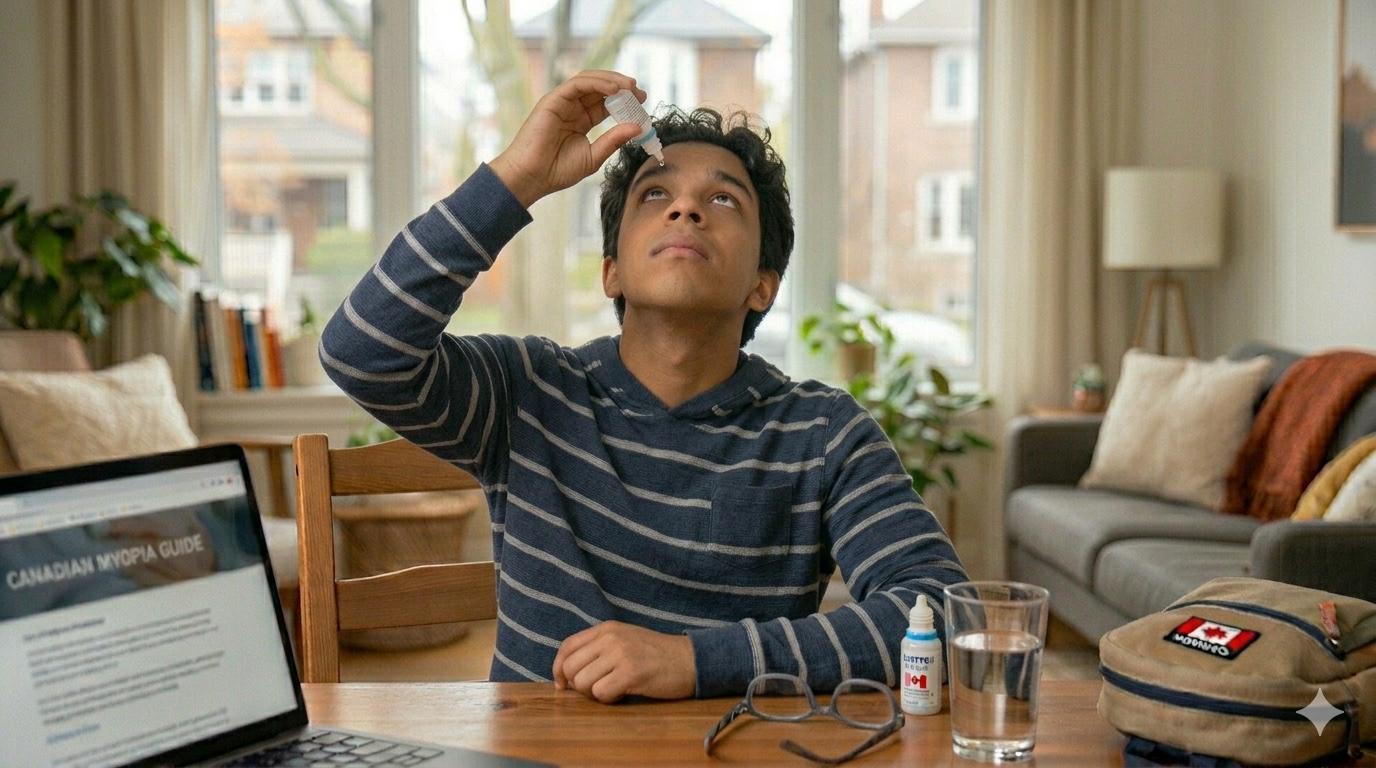
One drop in each eye, each night before bed
Bedtime dosing means any mild blur or light sensitivity happens while you sleep
Daily use is important—consistency matters for effectiveness
Duration:
Treatment continues while myopia is still progressing
For children and teens, this typically means ages 6-18, depending on when myopia stabilizes
We don't stop treatment abruptly—tapering helps prevent rebound progression
Routine:
The nightly routine takes about 30 seconds:
Wash hands
One drop in each eye (children may need parent assistance)
Close eyes briefly, wipe away the excess with a tissue
Done
Most families tell us it becomes automatic within a couple weeks, like brushing teeth.
Getting Atropine in Canada
Canadian families face a practical problem: low-dose atropine isn't commercially manufactured in Canada.
You can't pick it up at Shoppers Drug Mart. It has to be compounded.
The process:
Your optometrist prescribes atropine at the appropriate concentration
The prescription goes to a compounding pharmacy that specializes in ophthalmic preparations
The pharmacy prepares the drops in sterile conditions
You receive a supply (typically 1-3 months at a time)
Cost:
Compounded atropine typically costs $150-$300 for a 3-6 month supply, depending on the pharmacy and packaging format. This works out to roughly $300-$600 per year, making atropine the most affordable myopia control option.
Atropine Eye Drops for Progressive Myopia
If your myopia is getting worse year after year, atropine drops for myopia can help slow that progression. The rate of myopia progression varies by age. Children between 8 and 15 tend to progress the fastest, sometimes by -0.75 to -1.00 D per year. Without intervention, this can lead to high myopia by adulthood.
Atropine eye drops for progressive myopia are most effective when started early, during the years of fastest change. The earlier treatment begins, the lower the final prescription is likely to be.
Atropine Eye Drops for High Myopia
For patients who already have high myopia (over -5.00 D), atropine can still play an important role. While atropine can't reverse existing myopia, it can help prevent further progression and the increased risks that come with it—including retinal detachment, glaucoma, and myopic macular degeneration.
Atropine eye drops for high myopia are often used as part of combination therapy, paired with Ortho-K, Myopia Control glasses or contacts for maximum effect.
Comparing Myopia Control Treatment Options: Atropine vs. Ortho-K vs. Myopia Control Soft Contact Lenses
How does atropine compare to other myopia control treatment options?
Factor | Atropine | Ortho-K | Myopia Control Glasses or Contacts |
|---|---|---|---|
Effectiveness | 30-50% slower progression | 40-60% slower | 40-60% slower |
Ease of use | Very easy (one drop at bedtime) | Moderate (nightly lens wear) | Moderate (daily lens wear) |
Cost (annual) | $300-$600 | $500-$800 (after year 1) | $800-$1,200 |
Vision correction | No (still need glasses) | Yes (glasses-free days) | Yes (lenses correct vision) |
Age range | Ages 4+ | Ages 8+ typically | Ages 8-12 start |
When atropine might be the best choice:
Children (ages 6-17) progressing despite already using Ortho-K, Myopia control glasses or contacts
As an add-on to boost the effectiveness of lens-based treatments
Children progressing 0.50D or more per year or 0.2 mm or more in axial length.
Children with a family history of high myopia, early-onset myopia, or excessive near-vision activity.
Patients who cannot tolerate or fail to adhere to optical treatments (orthokeratology, specialized soft contact lenses, or glasses).
Combination Therapy: Atropine Plus Lenses
For patients with aggressive myopia progression, we combine atropine with other treatments:
Atropine + Myopia Control soft contacts: Atropine works through one mechanism; the lens optics work through another. Combining them may provide greater control than either alone.
Atropine + Ortho-K: Same principle—attacking myopia progression through multiple pathways.
Atropine + Myopia Control glasses: For those who want myopia control without contact lenses, this maximizes effectiveness. Atropine works through one mechanism; the lens optics work through another. Combining them may provide greater control than either alone.
Monitoring on Atropine
When you're on atropine therapy, we'll want to see you regularly:
Initial visits (first 3 months):
Check for side effects
Ensure proper administration technique
Assess early response
Ongoing monitoring (every 6-12 months):
Measure the myopia progression rate (is treatment slowing things down?)
Assess eye health
Adjust concentration if needed
Axial length measurement to track eye growth directly
We're not just looking at stable vision. We want slowed eye growth. Axial length measurement (how long the eyeball is) gives us the most accurate picture of whether treatment is working.
Common Questions
"Is atropine safe for long-term use?"
Atropine has been used in ophthalmology for over 100 years. The ATOM studies followed patients for 5+ years with no serious long-term effects. We monitor eye health throughout treatment, but the safety data is reassuring.
"What happens when I stop atropine?"
Some myopia progression may resume, though typically at a slower rate than before treatment. We taper the dose gradually rather than stopping abruptly to minimize rebound. For most patients, myopia naturally stabilizes by their late teens or early twenties, which is often when we discontinue treatment.
"Do I need to use atropine forever?"
There's no medical reason to continue once myopia stabilizes. At that point, the eyes have stopped growing, and myopia control is no longer needed. For adults who started treatment due to late-onset progression, treatment duration varies based on individual response.
"Will atropine affect work or school performance?"
At 0.01%, studies show no effect on reading speed, accommodation, or performance. At higher concentrations, some notice mild near blur, but it rarely affects daily activities. We monitor this closely.
"What if I miss a dose?"
Occasional missed doses aren't a problem—just resume the next night. Consistency matters over weeks and months, not single days. That said, developing a routine helps ensure regular use.
Special Considerations for Children
For pediatric patients, there are some additional considerations:
Administration: Young children often need parent assistance with drops
School activities: At low doses, there's no impact on reading, sports, or academics
Duration: Children typically use atropine longer (throughout their growth years) than adults with late-onset progression
Monitoring: We track axial length growth more frequently in children, as they're in their peak myopia progression years
Is Atropine Right for You?
Atropine may be a good fit if:
Your myopia is progressing (getting worse each year)
You're too young for contact lenses (under 8) or prefer not to wear them
Contact lenses aren't an option (discomfort, handling difficulty)
You want to add protection on top of other treatments
For children specifically:
Used in combination with one of the other optical myopia control treatment options
Can be started as early as age 4
Parents appreciate the simple bedtime routine
Atropine may not be ideal if:
You're extremely light-sensitive already
You have certain eye conditions (discuss with your doctor)
Compliance with daily drops would be challenging
Next Steps
If you're interested in atropine for myopia control, here's the process:
Schedule a myopia assessment so we can evaluate your current prescription, progression rate, and candidacy for treatment
Discuss your myopia control treatment options, including atropine, lenses, and combination approaches
Start treatment with appropriate monitoring
Adjust as needed based on response and progression
The earlier myopia control starts, the more progression we can potentially prevent. If your prescription is changing every year, it's worth getting assessed. For a side-by-side comparison of all approaches, see our myopia control options guide.
Ready to get started?
If you or your child's myopia is progressing, a comprehensive myopia assessment can determine whether low-dose atropine eye drops—alone or in combination with other treatments—are the right fit. Submit an inquiry(opens in new tab) and our team will be in touch.