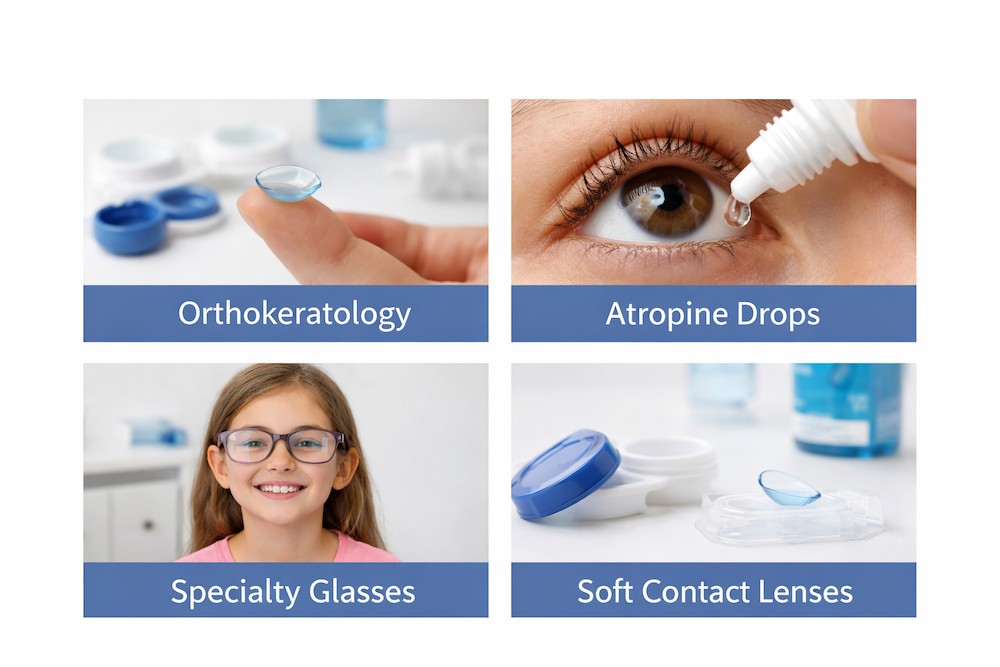
Myopia Control Options Compared: A Guide for Markham & Toronto Families

Dr. Melissa Yeung
·11 min read
Your eyes are getting worse every year—or you're watching this happen to your child. You've done the research and know that myopia control treatments exist—but now you're facing a confusing array of options. Ortho-K. MiSight. Atropine. Specialty glasses. What's the difference? Which one is right for you?
At Elevate Vision Care in Markham, we see this every week — families across Markham, Unionville, and the broader Toronto area navigating a confusing array of myopia control options. This guide breaks down each treatment available at our clinic so you can make a confident, informed decision.
Why Myopia Control Matters
First, let's address why this matters at all.
Myopia isn't just about needing stronger glasses. As myopia increases, so does the risk of serious eye diseases later in life:
Myopia Level | Retinal Detachment Risk | Myopic Maculopathy Risk | Glaucoma Risk |
|---|---|---|---|
Low (-1 to -3 D) | 3-4x normal | Low | Slightly elevated |
Moderate (-3 to -6 D) | 9-10x normal | Moderate | Roughly 2x normal |
High (over -6 D) | 12-22x normal | High | Roughly 3x normal |
These risk multipliers are drawn from Flitcroft's review of myopia epidemiology(opens in new tab) in Progress in Retinal and Eye Research, which found statistically significant disease associations even within the "mild" 0 to -6 D range, with retinal detachment and myopic maculopathy risks an order of magnitude higher at the high end. Published estimates vary between study populations, so treat these as ranges rather than fixed figures.
Every diopter of myopia prevented is meaningful. Keeping your child at -3.00 instead of -6.00 isn't just about thinner glasses—it's about substantially lower lifetime risk of vision-threatening conditions.
This is why myopia control isn't optional for anyone with progressive myopia. It's proactive healthcare.
The Four Main Options
Let's look at each treatment category in depth.
Option 1: Orthokeratology (Ortho-K)
What It Is
Ortho-K uses specially designed hard contact lenses worn overnight to temporarily reshape the cornea. You wake up with clear vision and go through the day without glasses or contacts.
How It Works
The lenses gently flatten the central cornea during sleep. This corrects myopia and creates optical changes across the retina that signal the eye to slow its growth. When the lenses are removed in the morning, the reshaping effect lasts throughout the day.
Effectiveness
In the ROMIO trial(opens in new tab), a 2-year randomized study published in Investigative Ophthalmology & Visual Science, children wearing Ortho-K lenses had 43% slower eye growth than children in regular glasses. Across the wider literature the effect typically lands in the 30-50% range, and the International Myopia Institute(opens in new tab) publishes clinical summaries reviewing this evidence.
The Experience
Nightly routine:
Insert lenses 15-20 minutes before bed
Sleep with lenses in place (6-8 hours minimum)
Remove lenses in the morning
Clean and store lenses for next night
Enjoy glasses-free vision all day
Adaptation period: Most patients adapt within 1-2 weeks. The first few nights may involve some lens awareness, and morning removal takes practice.
Cost in Markham/Toronto
First year: ~$2,500 (fitting, lenses, follow-ups)
Ongoing years: ~$1,200 (replacement lenses, monitoring)
Best For
Anyone who wants freedom from daytime glasses/contacts
Active individuals involved in sports, swimming, or dance
Patients aged 6+ with moderate myopia (-1.00 to -6.00 D)
Those committed to a consistent nightly routine
Children and teens with progressive myopia (excellent for slowing progression)
Not Ideal For
Patients with certain corneal conditions
Those who can't commit to the nightly routine
Pros and Cons
Pros | Cons |
|---|---|
Glasses-free during the day | Higher upfront cost |
No daytime lens handling | Nightly lens routine required |
Strong myopia control effect | Learning curve for insertion/removal |
Reversible (effects fade if stopped) | Requires consistent overnight wear |
Freedom for sports and activities | Not suitable for all prescriptions |
Option 2: MiSight Contact Lenses
What It Is
MiSight lenses are daily disposable soft contact lenses designed specifically for myopia control. They look and feel like regular soft contacts but have a special optical design that slows eye growth.
How It Works
MiSight uses "ActivControl" technology—concentric ring zones that create myopic defocus on the peripheral retina. This signals the eye to slow its elongation while still providing clear central vision for daily activities.
Effectiveness
A 3-year randomized clinical trial(opens in new tab) published in Optometry and Vision Science showed MiSight slows myopia progression by 59% compared to single-vision lenses. Six-year follow-up data(opens in new tab) confirms the effect is sustained with continued wear.
The Experience
Daily routine:
Insert fresh lenses each morning
Wear throughout the day
Remove and discard in the evening
No cleaning or overnight storage
Adaptation period: Similar to regular soft contacts. Most patients adapt within days.
Cost in Markham/Toronto
Annual cost: $1,000-$1,200 (includes lenses, fitting, follow-ups)
Cost remains consistent year over year
Best For
Patients already comfortable with contact lenses
Those who prefer daytime lens wear
Anyone who may forget overnight Ortho-K or sleeps irregularly
Simpler routine preference
Not Ideal For
Patients with dry eyes or allergies affecting contact lens comfort
Those who want to avoid all daytime lenses (prefer glasses-free)
Pros and Cons
Pros | Cons |
|---|---|
Simple daily routine | Daytime lens wear required |
No lens cleaning needed | Can't swim or shower with lenses |
Strong clinical evidence | Higher cost than glasses + atropine |
Familiar soft lens feel | Not glasses-free |
Daily disposables are hygienic | Limited prescription range |
Option 3: Low-Dose Atropine Eye Drops
What It Is
Atropine is a medication that, at very low concentrations (0.01%-0.05%), slows the elongation of the eye that causes myopia progression. It's administered as one drop in each eye at bedtime.
How It Works
The exact mechanism isn't fully understood, but atropine appears to act on receptors in the retina and sclera to slow eye growth. It doesn't correct vision—you still wear glasses or contacts—but it reduces how quickly your prescription changes.
Effectiveness
Studies show low-dose atropine slows progression by different amounts depending on concentration. The ATOM2 study(opens in new tab) in Singapore first showed that concentrations far below the traditional 0.5% dose still work, and the LAMP study(opens in new tab) in Hong Kong then compared 0.05%, 0.025%, and 0.01% head to head over one year:
0.01%: smallest effect — in the LAMP trial eyes still grew 0.36 mm in a year, against 0.41 mm on placebo; minimal side effects
0.05%: strongest effect — 0.20 mm of growth against 0.41 mm on placebo, roughly half the elongation; mild side effects
The Experience
Daily routine:
One drop in each eye at bedtime
Continue wearing regular glasses or contacts during the day
That's it
Adaptation: Virtually no adaptation needed. Some patients notice mild light sensitivity with higher concentrations.
Cost in Markham/Toronto
Annual cost: ~$500 (compounded drops plus monitoring visits)
Must be obtained from a compounding pharmacy
Best For
Anyone seeking the lowest-cost option
Patients who can't tolerate contact lenses
Adults with progressing myopia who want a simple solution
Add-on treatment to boost other myopia control methods
Not Ideal For
Those wanting vision correction included (atropine doesn't correct vision)
Anyone extremely sensitive to light
Cases where contact-based treatments are more suitable
Pros and Cons
Pros | Cons |
|---|---|
Lowest cost option | Doesn't correct vision (need glasses) |
Very easy administration | Requires compounding pharmacy |
Suitable for youngest children | Mild side effects possible |
Can combine with other treatments | May need dose adjustments |
No contact lens handling | Less effective than lenses alone |
Option 4: Myopia Control Spectacle Lenses
What It Is
Several specialty glasses lenses have been developed for myopia control, including:
DIMS lenses (Defocus Incorporated Multiple Segments)
HALT lenses (Highly Aspherical Lenslet Target)
DOT (Diffusion Optics Technology)
These look like regular glasses but incorporate optical zones that create peripheral defocus to slow eye growth.
Effectiveness
Clinical studies show these specialty lenses slow progression by 52-67%—comparable to or better than contact lens options. A 2-year trial of DIMS lenses(opens in new tab) (MiYOSMART) published in the British Journal of Ophthalmology showed 52% slower progression. Stellest HALT lenses showed up to 67% reduction in full-time wearers(opens in new tab) according to results published in JAMA Ophthalmology.
The Experience
Daily routine:
Wear glasses normally throughout the day
No special handling or care beyond regular glasses
Adaptation: Minimal. Most children adapt immediately.
Cost in Markham/Toronto
Per pair: $600-$800
Need new lenses as prescription changes (typically annually)
Annual cost: $600-$800
Best For
Anyone who prefers glasses over contacts
Younger children not ready for contact lenses
Those wanting the simplest possible routine
Patients with dry eyes or allergies that limit contact lens options
Not Ideal For
Active individuals who find glasses limiting for sports
Those who want to be glasses-free
Anyone who frequently loses or breaks glasses
Pros and Cons
Pros | Cons |
|---|---|
Simplest routine (just wear glasses) | Still need to wear glasses |
No eye touching required | Can be limiting for sports |
Comparable efficacy to contacts | Breakage/loss risk |
Suitable for young children | May need more frequent replacement |
No adaptation period | Less freedom than Ortho-K |
Side-by-Side Comparison
Efficacy data from peer-reviewed clinical trials.
Factor | Ortho-K | MiSight | Atropine | Specialty Glasses |
|---|---|---|---|---|
Effectiveness | 30-50% | 50-60% | roughly half at 0.05% | 52-67% |
Vision correction | Yes (glasses-free) | Yes | No (need glasses) | Yes |
Minimum age | ~6 | ~6 | ~4 | Any |
First year cost | ~$2,500 | $1,000-$1,200 | ~$500 | $600-$800 |
Annual ongoing | ~$1,200 | $1,000-$1,200 | ~$500 | $600-$800 |
Routine complexity | Moderate | Simple | Very simple | Simplest |
Contact lens handling | Yes (overnight) | Yes (daytime) | No | No |
Sports/swimming | Excellent (lens-free days) | Good (remove for water) | Depends on glasses | Limited |
Making the Decision: A Framework
Consider Age
Children Ages 4-7:
Atropine is typically the first option for pre-myopia if indicated
Specialty glasses if available and affordable
May transition to contacts later
Children & Teens Ages 6-17:
All options available
Match to lifestyle and preferences
Often the ideal age to start contact lens options
Adults 18+:
If myopia is still progressing, any option may help
Ortho-K excellent for vision correction + control
Atropine simplest add-on to existing glasses
Consider Lifestyle
Very active in sports:
Ortho-K provides the most freedom (glasses-free during all activities)
MiSight requires removal for swimming/water sports
Glasses limit certain sports
Irregular sleep schedule:
MiSight or atropine + glasses better choices
Ortho-K needs consistent 6-8 hours of wear
Anxious about eye touching:
Start with atropine + glasses or specialty lenses
May warm up to contacts over time
Consider Your Priorities
Lowest cost:
Atropine
Specialty glasses
Simplest routine:
Specialty glasses (just wear them)
Atropine (one drop at bedtime)
Most freedom:
Ortho-K (glasses-free days)
Consider Progression Rate
Rapid progression (>1.00 D/year):
Consider combination therapy (e.g., atropine + Ortho-K)
More aggressive approach justified
Moderate progression:
Single treatment usually sufficient
Monitor and adjust if needed
Combination Therapy: When One Isn't Enough
For patients with aggressive myopia—high prescription, rapid progression, strong family history—we sometimes combine treatments:
Atropine + Ortho-K:
Atropine addresses biochemical pathway
Ortho-K provides optical defocus
May provide greater control than either alone
Atropine + MiSight:
Same dual-mechanism principle
Often used when single treatment shows insufficient control
Atropine + Specialty Glasses:
Lowest-effort combination
Good for anyone who can't wear contacts
Combination therapy adds cost but may be worthwhile for high-risk cases. We typically try single treatments first and escalate if progression continues.
What Doesn't Work
Let's be clear about what doesn't control myopia:
Regular glasses: Correct vision but do nothing to slow progression. Your child's prescription will continue to worsen.
Regular contact lenses: Same as glasses—vision correction only.
Under-correction: Some old theories suggested prescribing weaker glasses. A two-year randomized study(opens in new tab) in Vision Research found the opposite: children left deliberately under-corrected progressed faster, not slower. Don't do it.
Getting Started
If myopia is progressing—whether in you or your child—here's the path forward:
Step 1: Comprehensive Myopia Assessment
We'll evaluate:
Current prescription
Rate of progression (comparing to previous exams)
Axial length (eye length measurement)
Corneal shape and health
Lifestyle and preferences
Step 2: Review Options Together
We'll discuss:
Which treatments suit your child's profile
Realistic expectations for each
Your family's priorities
Step 3: Begin Treatment
Once you've chosen a path:
For Ortho-K: Fitting appointments and training
For MiSight: Fitting and lens supply
For Atropine: Prescription to compounding pharmacy
For Specialty Glasses: Lens ordering and fitting
Step 4: Monitor and Adjust
Ongoing monitoring includes:
Regular progression checks
Axial length measurements
Treatment adjustments as needed
The Bottom Line
There's no single "best" myopia control treatment—only the best treatment for your situation. The right choice depends on age, prescription, lifestyle, and personal preferences.
What matters most is starting treatment. Every year of uncontrolled progression adds to lifetime myopia and associated risks. The research is clear: myopia control works, and earlier intervention provides the most benefit.
For children and teens: Early intervention is key—the sooner treatment starts, the more progression we can potentially prevent.
For adults: If your myopia is still changing, you're not "too old" for myopia control. The same treatments that work for children can help slow your progression too.
At Elevate Vision Care, we offer all major myopia control options and will help you find the right fit. If you're in Markham, Unionville, Scarborough, Richmond Hill, or the Toronto area, our team can help you find the right myopia control treatment for your child. Book your consultation(opens in new tab) to learn which approach makes the most sense for you.