Progressive Lenses vs. Bifocals: Which Should You Choose?

Dr. Jason Huang
·10 min read
If you've recently been told you need reading glasses or a bifocal correction, you've probably run into the progressive vs. bifocals question. It's one of the most common decisions I walk patients through, and there's no single right answer, it depends on your visual needs, your lifestyle, and whether you're willing to spend a week or two adjusting to something new.
Here's what I tell patients when they're sitting across from me, trying to figure it out.
What is presbyopia, and why do you suddenly need two prescriptions?
Around your early 40s, you might notice that your arms aren't quite long enough. You're holding your phone further away to read it, or pulling your reading glasses down to look over them when someone across the table says something. That's presbyopia (pronounced prez-bee-OH-pee-ah), the gradual loss of near focusing ability that happens to everyone as they get older.
The cause is purely mechanical. The lens inside your eye gradually stiffens with age. When you're young, it flexes easily to shift focus between near and distant objects. Past 40, it becomes progressively less flexible, and close-up tasks start to blur or strain your eyes. By the mid-40s to early 50s, most people need correction for both distance and near.
That's where bifocals and progressive lenses come in. Both correct for multiple distances in a single pair of glasses. The difference is in how they do it.
Bifocals: the original two-in-one lens
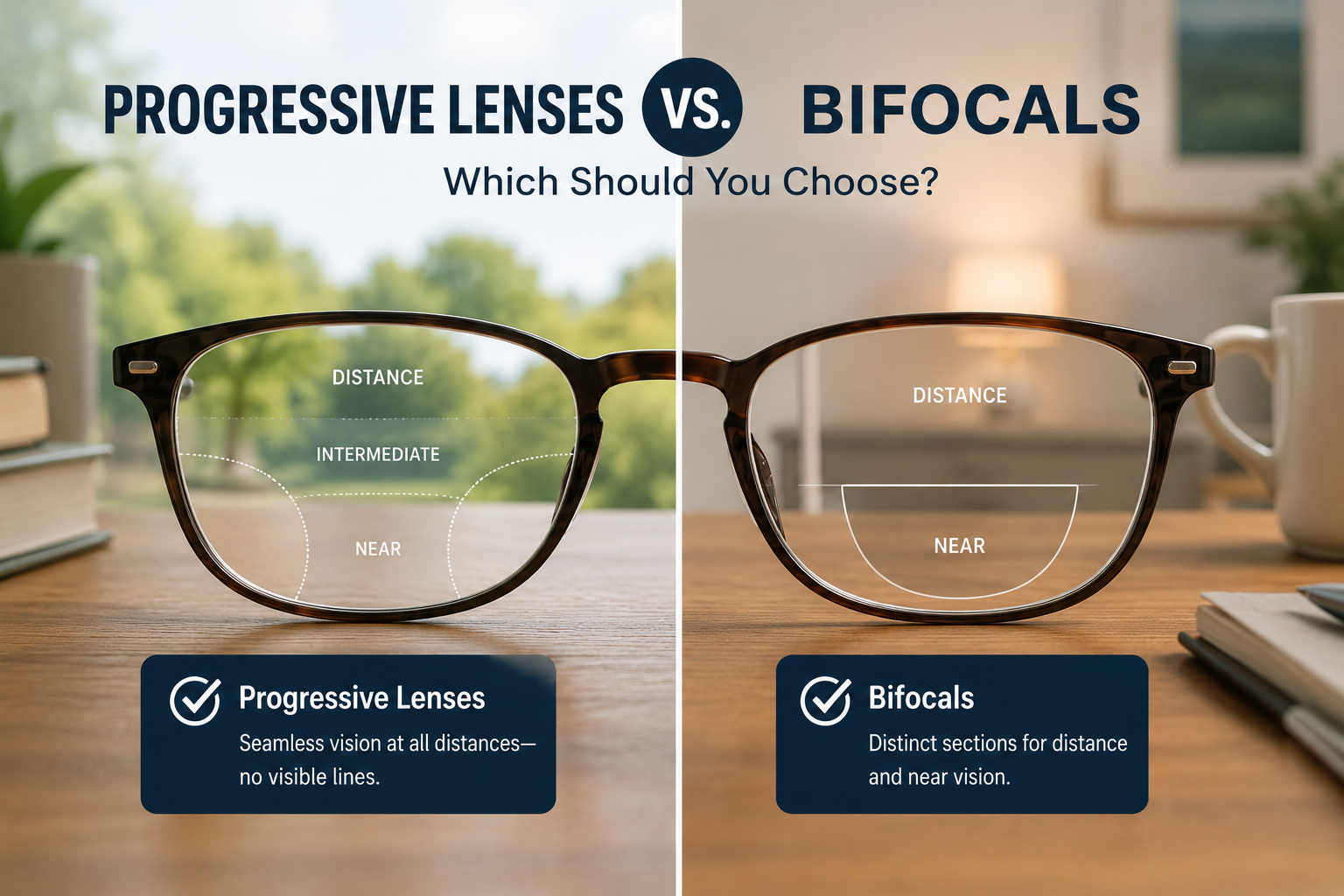
A bifocal lens is split into two zones by a visible horizontal line. The upper portion corrects your distance vision, driving, watching TV, seeing across a room. The lower segment corrects near vision for reading, close work, and screens.
The line is real and visible, both to you and to anyone looking at you. When your eyes cross that boundary, vision shifts abruptly. That sudden shift is called “image jump,” and it's noticeable at first. Most bifocal wearers adapt to it quickly, but it never fully disappears.
Bifocals have been around for centuries, attributed to Benjamin Franklin, though historians debate how much he actually had to do with the design. They're reliable, well-understood, and optically simple. There's no narrow corridor to navigate, and the large near zone at the bottom makes sustained close reading comfortable for many patients.
What bifocals lack is an intermediate zone. The area from about 50 cm to 1 metre, about an arm's length, has no dedicated correction. Computer screens, dashboard instruments, and store shelves all fall in this in-between distance where neither zone is ideal.
Progressive lenses: no line, three zones
Progressive lenses (also called no-line bifocals by patients who've heard the term, or varifocals in some countries) solve the intermediate problem by creating a gradual power change from the top of the lens to the bottom. Distance correction sits at the top, near correction at the bottom, and a corridor of intermediate vision runs through the middle.
There's no visible line. From the outside, the lens looks like a single-vision lens. That matters to many patients, more on that in a moment.
The tradeoff is that the transition zones aren't optically perfect. The sides of the lens, where the intermediate corridor blurs into the near zone, have some distortion. You learn to aim your gaze through the center of the lens rather than its periphery, and you move your head more than you did with single-vision lenses. This takes days to weeks to feel natural.
Once you're through the adaptation period, though, the visual experience is genuinely better for most activities. A 1995 prospective clinical trial(opens in new tab) of 265 experienced bifocal wearers who switched to progressive lenses found that progressive lenses ranked significantly higher than lined bifocals across all visual questions, and 92% of those patients preferred progressives. The authors' conclusion: progressive lenses should be the default choice for bifocal wearers considering a change.
The stigma factor, and why it's worth addressing honestly
A lot of my patients in their mid-40s come in and say, unprompted, “I don't want the line.” They connect the visible bifocal line with looking older, and they're right that the association exists. Bifocals have been around long enough that the line carries a cultural signal.
I'm not going to pretend that's vanity. It's a reasonable thing to care about. Progressive lenses are more expensive partly because they're technically more complex, but their aesthetic advantage is real. If you're going to wear something on your face every waking hour, how it looks and how it makes you feel about yourself matters.
That said, it's worth being honest in the other direction too: progressives have their own learning curve, and some patients, particularly those who've worn lined bifocals for years, genuinely find the switch difficult. If the main reason you want progressives is to avoid looking old, and you end up frustrated with them after three weeks, the outcome isn't good for anyone.
Head-to-head comparison
Feature | Progressive Lenses | Bifocal Lenses |
|---|---|---|
Visible line | No | Yes |
Vision zones | Distance, intermediate, near | Distance and near only |
Adaptation time | Days to 2–3 weeks | Minimal |
Peripheral distortion | Yes, especially at first | Minimal |
Near zone width | Narrower | Wider |
Intermediate (computer) vision | Yes | No |
Typical lens cost | $175–$800+ | Less expensive |
Best for | Most adults; those who want no visible line; computer users | Those who've had difficulty with progressives; wide near-zone tasks |
How well do people actually adapt to progressives?
Better than most first-timers expect. A 1991 study of 280 patients(opens in new tab) published in the Journal of the American Optometric Association found a 97.5% acceptance rate for progressive lenses, with no significant difference based on gender, degree of presbyopia, or previous lens history. A similar study by Krause found that 96% of participants rated progressive lenses as “good or very good”(opens in new tab), and every bifocal wearer who adapted to progressives in that study abandoned bifocals permanently.
The key phrase there is “who adapted.” An earlier UK study put the clinical success rate at roughly 80–86% for progressive lens wearers(opens in new tab), meaning a meaningful minority find them difficult. Adaptation depends heavily on prescription complexity, the specific lens design, and whether the fitting measurements were done carefully.
If you've tried progressives before and found them disorienting, it's worth asking whether the problem was the lens design or the fitting. Wider optical zones in newer designs, including digitally surfaced progressives, can make a real difference for patients who struggled with older-generation lenses.
What do progressives actually cost, and are they covered?
In Canada, lenses are not covered by OHIP. If you're wondering whether your eye exam qualifies for coverage, our guide to OHIP eye exam coverage in Ontario explains exactly who's eligible and for what. Eyeglass lenses themselves, regardless of type, are an out-of-pocket expense unless you have private insurance through work.
Standard progressive lenses typically start around $175–$250 per pair for lenses alone, before frames and coatings. Premium digitally surfaced progressives run higher, often $600–$800 for the lenses. Bifocals are generally less expensive, which is worth factoring in if cost is a constraint.
That price gap is one of the most common questions I get. Progressive lenses require more complex manufacturing. The gradual power change across the lens surface means each lens is individually calculated and ground, you can't just mass-produce them the way you can a two-zone bifocal. For patients with higher or more complex prescriptions, the case for premium progressives is strong. For milder corrections, standard progressives often work well.
Who is each lens actually best for?
Choose progressive lenses if:
You want seamless vision at all distances, including intermediate
You work at a computer regularly
You've never worn bifocals and are choosing for the first time
You're willing to spend a week or two adapting
The visible line bothers you
Consider bifocals if:
You've tried progressives before and genuinely couldn't adapt
Your work or hobbies require a very wide, unobstructed near zone
You do fine with just two distances and rarely need intermediate
Budget is a significant factor
One more group worth mentioning: patients who already wear contact lenses and are reaching the age where near vision is declining. If you're considering multifocal contact lenses, the comparison with glasses involves a different set of trade-offs, that's a conversation worth having at your exam.
“No-line bifocals”
Patients often come in asking for “no-line bifocals,” having heard the term from a friend or family member. To be clear: this is another name for progressive lenses. What your friend was describing is almost certainly a progressive lens, which does have two or more zones but no visible dividing line. The term is confusing but common, so it's worth knowing they mean the same thing.
Getting the fitting right matters more than people realize
The single biggest reason progressive lens wearers struggle is poor fitting measurements. The corridor of clear intermediate vision in a progressive lens is narrow, typically 8–12mm wide depending on the design. For that corridor to land in the right place when you look ahead, the optician needs accurate measurements of your pupillary distance, the height of your pupils relative to the frame, and how the frame sits on your face.
If those measurements are off by a few millimetres, the lens performs poorly no matter how good the design. If you've had progressives before and found them uncomfortable, ask about the fitting process next time.
The same principle applies to digitally surfaced progressive lenses, which can also account for vertex distance (how far the lens sits from your eye) and the tilt of the frame. These variables are why precise fitting matters, and why a professional fitting makes a real difference in how well progressive lenses actually perform.
The adaptation period is real
If you choose progressives, go in with realistic expectations. The first few days often involve some mild dizziness or a feeling that the floor is slightly off. That's normal, your brain is learning to use a new visual system, and it takes a little recalibration.
Most people feel comfortable within one to two weeks. During that time, the main adjustment is learning to move your head to aim your gaze through the correct zone rather than just swiveling your eyes. Looking at a menu? Slightly lower your gaze. Checking a sign? Look straight ahead through the top of the lens.
Wearing them consistently from the start is important. Switching back to old glasses during the adjustment period resets the clock.
Ready to figure out which option fits you?
The honest answer is that most of my patients who switch from bifocals to progressives are glad they did, but the adaptation period is real and worth knowing about before you commit. Coming in for a comprehensive eye exam is the best way to get a clear picture of your prescription, talk through both options, and get an honest recommendation based on your specific situation.
Book an eye exam(opens in new tab) and we'll help you sort it out.