Digitally Surfaced Lenses vs Stock Lenses: Is the Upgrade Worth It?

Dr. Jason Huang
·6 min read
You’re at the optical counter picking up new glasses. The optician gives you the total and mentions an upgrade option: “digitally surfaced” lenses. Sometimes they’re called free-form, or high-definition. The price jump is noticeable. The explanation, usually, is vague. You leave wondering whether that’s a real difference or just a way to pad the bill.
For some patients, it’s a genuine improvement. For others, standard stock lenses work just as well. The distinction comes down to how complex your prescription is.
Here’s what the technology actually does, and how to figure out which side you fall on.
What are stock lenses?
Most eyeglass lenses start as pre-made blanks, curved discs of optical material produced in batches to standard parameters. The lab grinds one or both surfaces to bring the lens close to your prescription. Conventional surfacing machines work in fixed increments of 0.125 to 0.25 diopters, according to the American Optometric Association(opens in new tab). If your prescription falls between two steps, the lab rounds to the nearest one.
For mild prescriptions, that rounding doesn’t cause problems. Stock lenses are cheaper, faster to produce, and optically fine for straightforward corrections. They’re the right choice for a lot of patients.
What are digitally surfaced lenses?
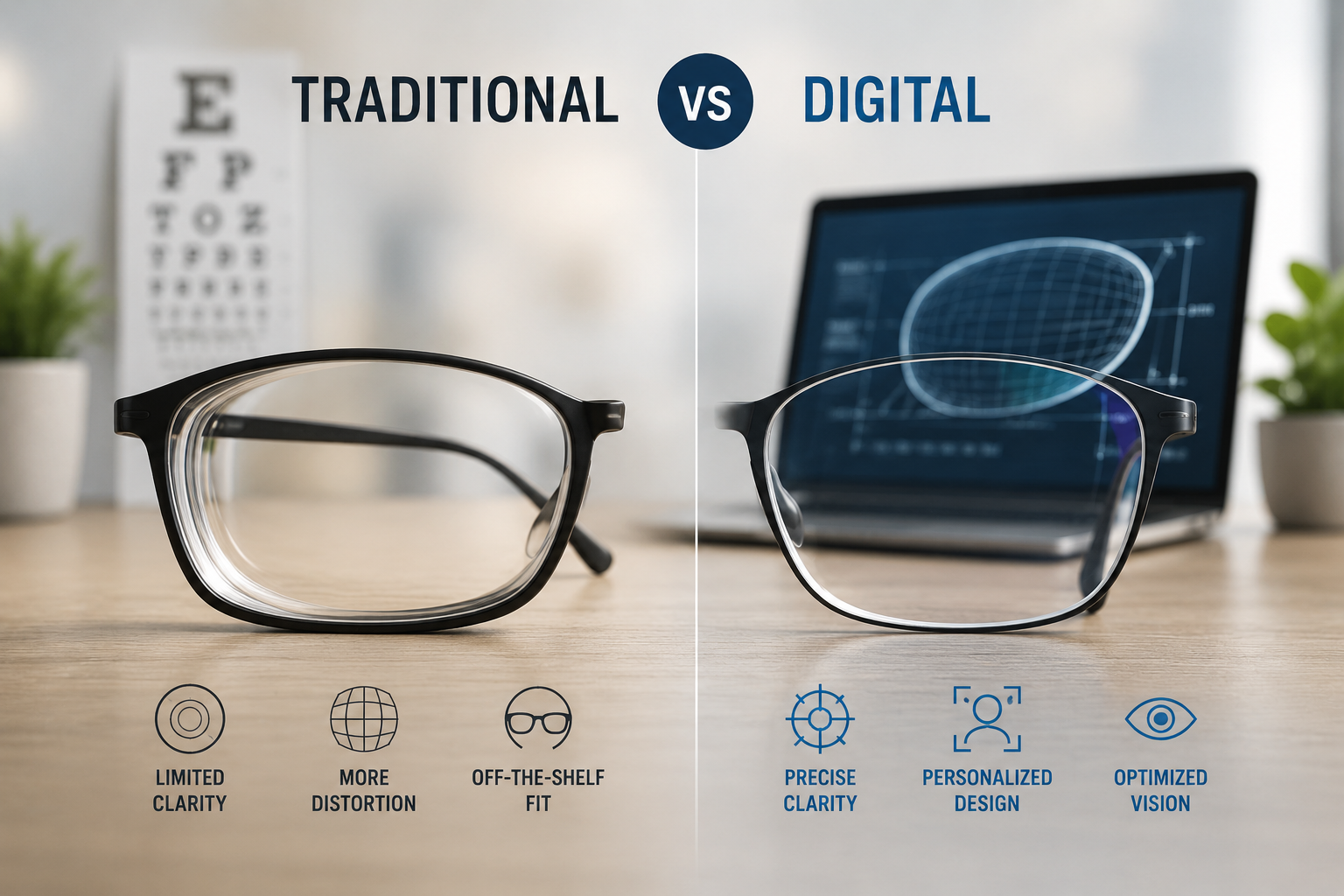
Digitally surfaced lenses — also called free-form lenses or high-definition (HD) lenses — use computer-controlled (CNC) equipment that works at 0.01 diopter increments. The American Optometric Association(opens in new tab) describes this as about six times more precise than conventional machining, with up to 20% more usable vision channels in progressive designs.
The surfacing happens on the back of the lens — the side that faces your eye. That matters because the inner surface can be individualized not just to your prescription but to how you’ll actually wear the glasses. Pupillary distance, vertex distance (the gap between the lens and your eye), and the tilt of the frame can all be factored into the calculation.
The result is a lens made for your specific eyes, face, and frame, not a generic blank trimmed to approximate your Rx.
How do they actually compare?
All lenses produce some distortion away from the optical center. It’s a basic property of curved surfaces, and both stock and digitally surfaced designs try to minimize it, they just work from different starting points.
A 2026 systematic review published in Cureus(opens in new tab) that analyzed more than 90 peer-reviewed studies found that free-form lenses can reduce peripheral astigmatism by as much as 50% compared to conventional aspheric lenses. The same review found wider usable fields of clear vision, particularly in progressive designs, and better contrast sensitivity in low-light conditions.
That 50% figure is hard to visualize until you wear them. The zone where your vision is actually sharp gets larger. Peripheral blur and swim decrease. For progressive wearers, the near and intermediate zones are often the first thing people notice.
A 2011 clinical trial in the Journal of Optometry(opens in new tab) put numbers to it: the horizontal extent of clear vision at reading distance was significantly wider with customized free-form progressive lenses, and participants rated their overall satisfaction higher.
Who gets the most out of them?
The short version: the more complex your prescription, the bigger the difference.
Higher prescriptions are where it shows up most clearly. The Cureus review found free-form lenses are generally preferable for prescriptions above ±4 diopters, where conventional designs struggle more with off-axis aberrations. If you’re reaching for your glasses the moment you wake up, you’re likely in this group.
Significant astigmatism is another situation where the precision matters. For astigmatism above 2 diopters, the individualized back-surface calculation compensates for how cylindrical corrections interact with lens curvature in ways that standard designs can’t fully address.
Progressive lens wearers are probably the most consistent beneficiaries. Wider near and intermediate zones mean less head movement to find the reading spot and faster adaptation for first-time progressive wearers. If you’ve tried progressives before and found them disorienting, it’s worth trying a free-form design before writing them off — the distortion many people experience with standard progressives is partly a function of narrow optical zones, not just a matter of adjustment time.
People who spend long hours in visually demanding environments also tend to notice a difference. Reduced peripheral distortion and better contrast sensitivity in low light can translate to real reductions in eye fatigue by the end of a long workday, especially when you’re switching between screens, documents, and distances throughout the day.
What about single vision lenses?
The same CNC process applies to digital single vision lenses, and the same logic holds, just with smaller margins. For a simple prescription like -1.00 with no astigmatism, there’s not much optical benefit in daily use. Most patients in that range won’t feel a difference.
Where it becomes worth considering: higher single vision prescriptions, significant astigmatism, or anyone who’s had trouble with lens comfort despite an accurate Rx. If standard lenses have never quite felt right and you can’t explain why, digital surfacing is worth trying before assuming the problem is your prescription.
So is the upgrade worth it?
Honestly, not automatically, and not for everyone.
For mild, uncomplicated prescriptions, stock lenses are fine. The optical demands are modest enough that the precision gap doesn’t show up in daily use. Paying for the upgrade wouldn’t buy you anything.
For higher prescriptions, significant astigmatism, progressive lens wearers, or people with ongoing comfort issues, the research supports it. Better peripheral clarity and wider reading zones aren’t marketing language; they’re documented, measurable improvements.
A practical note: eyeglass lenses in Canada aren’t covered by OHIP for most adults (children’s exams are a different matter; here’s our guide to OHIP eye exam coverage in Ontario for the full breakdown). With costs fully out-of-pocket, you deserve a straight answer before agreeing to an upgrade. That conversation is best had at your eye exam, where we can look at the actual prescription and tell you whether the difference is likely to matter for you.
If you’re also working through lens options for a child and myopia is part of the picture, our comparison of myopia control options covers where specialty lens designs fit relative to other treatments.
Questions worth asking at the dispensary
When you’re being quoted for premium lenses, get clear answers to these before committing:
Does my specific prescription fall in a range where digitally surfaced lenses would make a noticeable difference?
Is this progressive lens being customized to my specific frame and fitting measurements, or just to the prescription power?
Is there an adaptation guarantee if the lenses don’t feel right?
Ready to find out what your prescription actually needs?
If you’re not sure whether the upgrade is the right call, or if you’ve had ongoing trouble with lens comfort, a comprehensive eye exam is where that conversation starts. We’ll go through your prescription in full, talk through what lens design fits your vision needs and daily habits, and give you a clear answer.
Book an eye exam(opens in new tab) and we’ll be in touch.