How to Read a Glasses Prescription: OD, OS, SPH, CYL, AXIS, ADD & PD Explained

Dr. Jason Huang
·8 min read
You're sitting in the car after your eye exam, prescription in hand. You look at the paper and see a table full of abbreviations (OD, OS, SPH, CYL, AXIS) followed by numbers you've never had to decipher before. It's not obvious, and no one handed you a glossary on the way out.
This guide explains how to read a glasses prescription in plain language. Every abbreviation, every number, what the signs mean, and what to do with the information.
The Quick-Reference Table
Here's a summary you can bookmark. The full explanations follow.
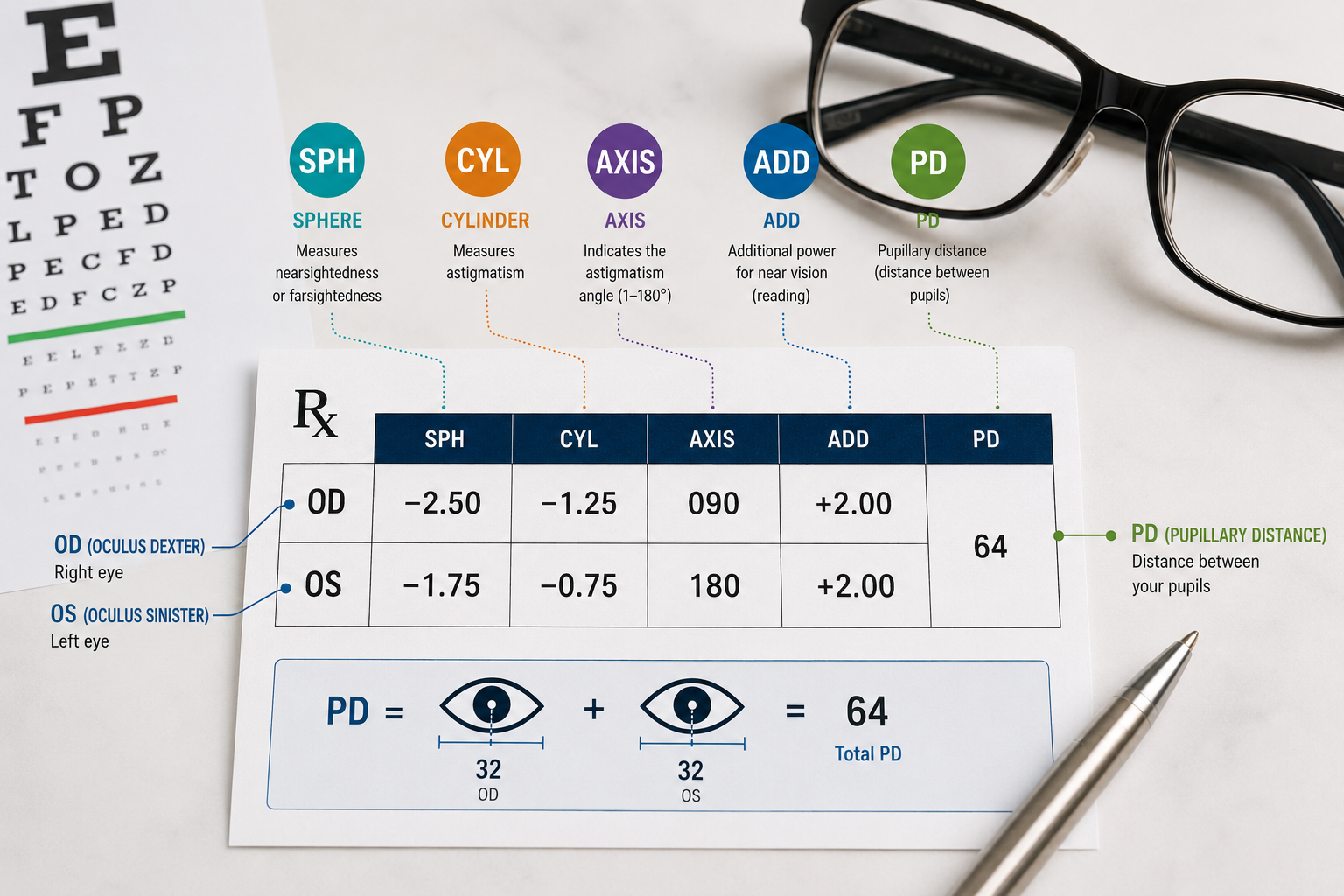
Abbreviation | Full Name | What It Means |
|---|---|---|
OD | Oculus dexter | Your right eye |
OS | Oculus sinister | Your left eye |
OU | Oculus uterque | Both eyes together |
SPH | Sphere | Main lens power — corrects nearsightedness or farsightedness |
CYL | Cylinder | Astigmatism correction — blank means no astigmatism |
AXIS | Axis | Orientation of astigmatism, in degrees (1–180) |
ADD | Addition | Extra reading power for progressive or bifocal lenses |
PD | Pupillary distance | The distance between your pupils, in millimetres |
OD and OS: Which Eye Is Which?
The right eye is labelled OD, from the Latin oculus dexter. The left eye is OS, from oculus sinister. You'll see these as column headers on your prescription, with a separate row of numbers for each eye. Some prescriptions use R and L instead. The abbreviations vary by clinic, but the meaning is the same.
The reason your eyes are listed separately is that they often need different corrections. It's common to be more nearsighted in one eye than the other, or to have astigmatism in only one eye. If you see a third row labelled OU (oculus uterque), that value applies to both eyes at once — usually the ADD for reading, which is typically the same for both.
SPH: The Main Lens Power
SPH stands for sphere and is the first number listed for each eye. It's the primary correction for nearsightedness or farsightedness, measured in diopters (D), the unit used to express lens power.
The sign in front of the number matters:
Minus (-) means you're nearsighted. Things far away are blurry; close-up is fine. The light entering your eye is focusing slightly in front of the retina instead of on it.
Plus (+) means you're farsighted. Close-up tasks are harder; you may strain to read or feel eye fatigue. The focus point falls behind the retina.
The further that number is from zero in either direction, the stronger your correction needs to be. All About Vision classifies prescription strength(opens in new tab) like this for nearsightedness: mild is -0.25 to -2.00, moderate is -2.25 to -5.00, and high is anything below -5.00. The same thresholds apply on the plus side for farsightedness.
A prescription of -1.50 is relatively mild. One at -6.00 is considered high myopia and carries higher long-term risks to eye health beyond just blurry distance vision. If your child's prescription is climbing each year, that trajectory is worth discussing with your optometrist — our comparison of myopia control options covers what's available in Canada to slow that progression.
If a prescription reads plano or Pl under SPH, it means zero correction is needed in that eye. You might see this if you only have astigmatism with no underlying nearsightedness or farsightedness.
CYL and AXIS: The Astigmatism Pair
These two always go together. If your CYL column is blank or zero, you can skip this section, this means you don't have significant astigmatism needing correction.
CYL stands for cylinder and measures how much astigmatism you have. Astigmatism means the front surface of your eye (the cornea) or the lens inside your eye isn't perfectly round. Instead of being like a basketball, it's slightly oval, like a rugby ball. That uneven curve means light doesn't focus to a clean point on the retina, causing blur or ghosting at any distance.
The CYL value is also measured in diopters, and like SPH, it can carry a minus or plus sign depending on how your optometrist's system notates it. Both notations are correct; they just reflect different conventions that can be converted between.
AXIS tells the lens maker where on your cornea that unevenness sits. It's a number between 1 and 180, measured in degrees. Think of it like the orientation of the oval: an axis of 90 means the steeper curve runs vertically, while 180 means it runs horizontally. The axis number itself doesn't tell you anything about severity, that's the CYL value's job. Axis is purely directional.
A CYL value without an axis would be meaningless to the lab; they work as a unit.
ADD: The Reading Boost
ADD, short for addition power, only appears on your prescription if you need help with near vision like in bifocal or progressive lenses. It's extra magnifying power added to the lower portion of the lens for near vision , usually to compensate for presbyopia.
Presbyopia is the gradual stiffening of the natural lens inside your eye that happens to most people starting in their early-to-mid 40s. The lens loses flexibility and becomes harder to adjust for close-up focus. You notice it when you start holding your phone further away to read, or when restaurant menus become difficult in dim light.
According to All About Vision(opens in new tab), ADD values typically range from +0.75 to +3.00 diopters. Lower numbers suggest early presbyopia; higher values reflect more significant near-focus loss. The ADD is almost always the same for both eyes, even when your distance prescription differs between them.
If you're in your mid-40s or older and your optometrist recommends progressive lenses, the ADD value is the number that makes those lenses work for reading. If you're weighing the difference between standard and premium progressive lenses, our post on digitally surfaced lenses vs. stock lenses explains how the lens construction affects how wide and clear that reading zone actually is.
PD: Pupillary distance
PD stands for pupillary distance, the measurement in millimetres between the centres of your two pupils. It's what the lab uses to position each lens's optical centre directly in front of your eye.
Get this wrong and your glasses may technically match your prescription but still feel off. A misaligned optical centre can cause eye strain, headaches, or a persistent sense that something isn't quite right, even when the powers are correct.
The Canadian Association of Optometrists(opens in new tab) notes that without a correct PD, wearers may experience eyestrain, distorted vision, or an inability to wear their glasses comfortably.
PD can be expressed two ways:
Single PD (binocular): one number representing the full distance between pupils, typically in the 60–65 mm range for adults according to All About Vision(opens in new tab).
Dual PD (monocular): two numbers representing the distance from each pupil to the nose bridge separately, such as 32/31. This is more precise and preferred for progressive lenses.
In Canada, whether PD is measured by the optometrist or the dispensing optician can vary by province and by practice, so it's worth asking directly rather than assuming it's included on your printed prescription.
What About Prism?
Some prescriptions include a prism value, usually written with a number and a direction abbreviation (BU = base up, BD = base down, BI = base in, BO = base out). Prism isn't a power correction, it's used when the eyes have trouble aiming at the same point simultaneously, causing double vision or eye strain from the effort of keeping images fused.
Most routine prescriptions don't include prism. If yours does, it means your optometrist found an alignment issue worth correcting in your lenses.
How Long Is a Glasses Prescription Valid?
In Ontario, a glasses prescription is valid for one to two years for adults, though this can vary. Children's prescriptions may expire sooner because vision changes faster during development.
If your prescription has expired, you'll need an updated eye exam before getting new glasses. For adults aged 20–64, that exam isn't covered by OHIP unless you have a qualifying medical condition, our guide to OHIP eye exam coverage breaks down exactly who qualifies and what the exam costs out-of-pocket.
Why the fitting matters as much as the prescription
A prescription tells the lab what powers to put in the lenses. It doesn't tell them how to position those lenses in front of your eyes in your specific frame. That's what the fitting is for.
When you pick up glasses at a clinic, an eye care professional adjusts the frame to your face, confirms the PD measurement is accurate, and checks that the optical centres are sitting in the right position. For simple prescriptions, that step is quick and easy. For higher powers, significant astigmatism, or progressive lenses, those measurements matter a lot more, even a small positioning error can make the glasses feel off.
If you've ever had glasses that were technically correct on paper but never felt quite right, fitting is usually where the issue was.
Ready to Get Your Eyes Examined?
Understanding your prescription is the first step. Getting an accurate one is the second. If it's been more than a year since your last exam, or you're noticing changes in your vision, a comprehensive eye exam will give you an up-to-date prescription and a clear picture of your eye health overall.
Book an eye exam(opens in new tab) and we'll be in touch.