Are Photochromic Lenses Worth It? An Optometrist's Honest Take

Dr. Jason Huang
·9 min read
You're at the optical counter, new prescription in hand. The optician mentions that photochromic lenses, you might hear them called Transitions, light-adaptive, or variable-tint lenses, are available as an upgrade. The price is noticeably higher. The explanation is usually short.
So you pull out your phone and search whether it's actually worth it.
I'm going to give you the honest answer, including the part that patients often aren't told until after they've bought them.
What Are Photochromic Lenses?
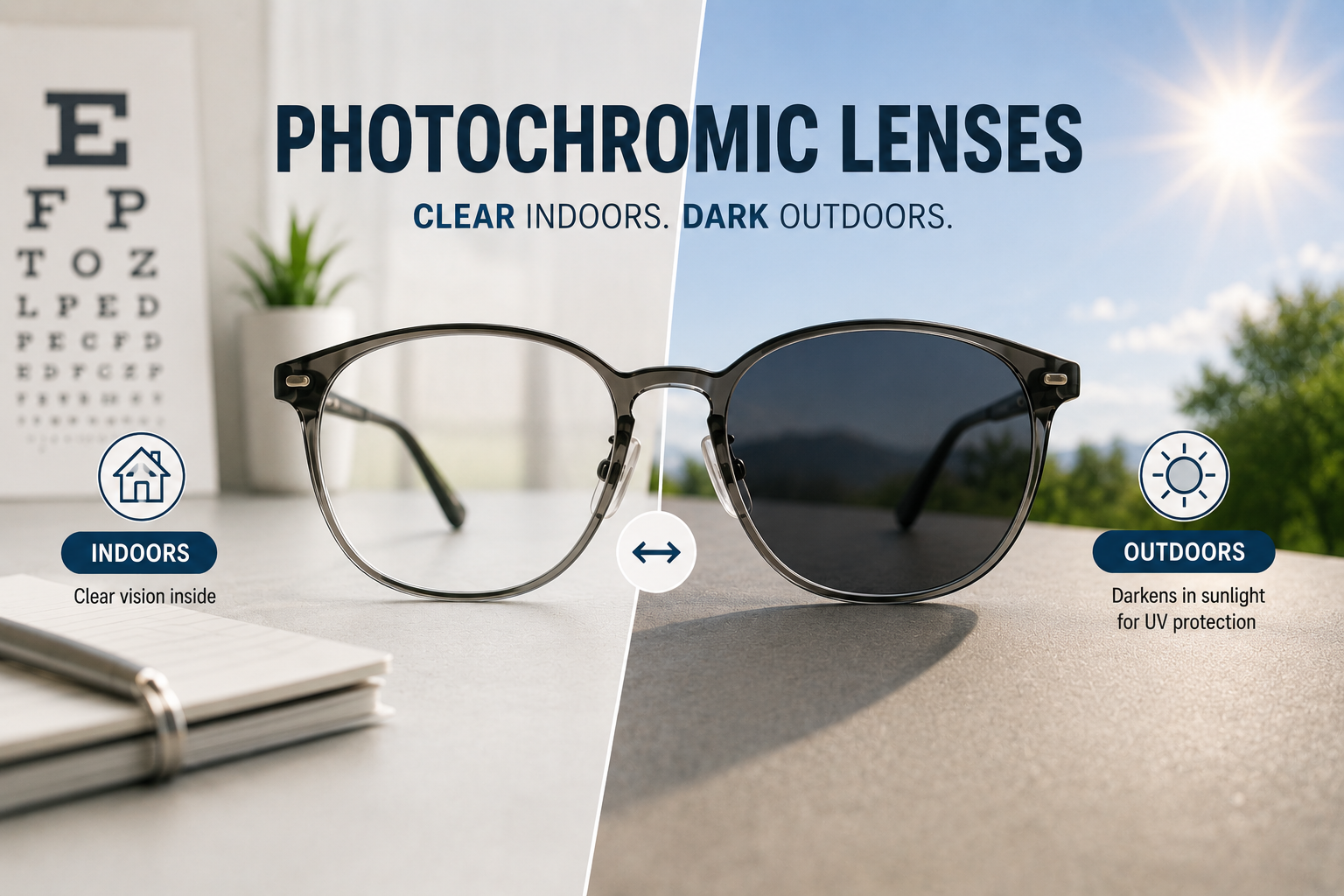
Photochromic lenses contain light-sensitive molecules embedded in the lens material. Outdoors, when those molecules are hit by ultraviolet (UV) radiation from sunlight, they change shape. That change in shape absorbs more visible light, which is what makes the lens appear darker. When you go back inside and the UV source is removed, the molecules reverse the process and the lens clears again.
The technology has been around since the 1960s, but modern versions are significantly faster and more durable than the originals.
Transitions (by EssilorLuxottica) is the best-known brand and so dominant that many people use the name generically, the same way people say “Kleenex” for any facial tissue. Other manufacturers make photochromic lenses too: Sensity is made by Hoya, and PhotoFusion is Carl Zeiss's version. The underlying chemistry differs between brands, which affects speed, darkness level, and how they perform in cold versus warm weather.
How Fast Do They Actually Work?
Modern photochromic lenses darken in roughly 30 to 60 seconds when you step outside. Clearing, returning to fully transparent indoors, takes about two to three minutes under normal conditions.
Temperature changes that timing. In cold weather, the molecules move more slowly, so the lenses darken more deeply but take longer to clear. On a cold Canadian winter day, your lenses might stay noticeably tinted for five minutes or more after you come inside. In summer heat, the opposite happens: lenses may not darken as deeply but they clear faster.
That cold-weather effect catches some patients off guard, especially if they bought the lenses in spring or summer and first notice it in November.
The Car Problem (And Why Nobody Tells You Until After)
The one thing I always tell patients before they commit to photochromic lenses is the car problem. It's not a flaw or a manufacturing defect. It's physics.
Modern car windshields are designed to block UV radiation. That's a good thing for your skin and eyes, but it's the same UV radiation that activates photochromic lenses. Inside a car, even on a bright, sunny day, your lenses will stay mostly clear. You still need sunglasses for driving.
This is the most common complaint I hear from patients who bought photochromic lenses without understanding this limitation. They expected their glasses to double as sunglasses during their commute, and they don't.
There is a partial solution. Transitions XTRActive lenses are designed to activate with visible light as well as UV, which means they darken somewhat behind glass. They will be noticeably tinted while driving in bright sun. However, they still don't reach the same darkness level as they would in direct outdoor sunlight, and they do have a faint residual tint indoors that some wearers find distracting.
If driving in bright conditions is your main concern, dedicated polarized sunglasses will outperform any photochromic option.
What the Research Actually Shows
A 2016 clinical study published in Clinical and Experimental Optometry(opens in new tab) tested three photochromic lens types in 75 adults and found that activated photochromic lenses produced statistically significant improvements in glare disability, contrast sensitivity, and recovery time after bright light exposure, compared to clear lenses. The effect was measurable across all lens types tested.
A separate crossover study of Transitions lenses(opens in new tab) had 52 patients wear photochromic lenses and clear lenses for 30 days each. After the trial, 85% of participants preferred the photochromic option, citing improvements in comfort, reduced squinting, and overall satisfaction with outdoor activities.
Photochromic lenses also provide 100% UVA and UVB protection when darkened outdoors, a benefit that clear lenses alone cannot offer. Long-term UV exposure to the eyes is a contributing factor to cataracts and macular degeneration, so this isn't trivial. Clear lenses can include a UV-blocking coating, but photochromic lenses provide that protection by design.
Who Gets the Most Out of Photochromic Lenses
Based on what I see in practice, photochromic lenses tend to work best for people who:
Spend a lot of time moving between indoors and outdoors, running errands, walking to lunch, doing outdoor work, or spending time with kids at the park. The convenience of not switching glasses pays off when the transitions happen frequently.
Find carrying a second pair inconvenient, some patients genuinely dislike keeping track of two pairs, and a photochromic lens solves that for everyday wear.
Are light-sensitive, patients who squint in moderate outdoor light, or who find bright overhead lighting uncomfortable, often report that photochromic lenses reduce that fatigue meaningfully.
Children and teenagers — a 2006 study in Optometry and Vision Science(opens in new tab) found that 88% of children aged 10–15 chose to continue wearing photochromic lenses after a two-week trial, and parents rated the experience equally positively. Kids often lose or forget sunglasses, making photochromic glasses a practical way to ensure consistent UV protection.
Who Probably Won't Get Full Value
Photochromic lenses are a harder sell for patients who:
Do most of their sun exposure while driving — as discussed above, standard lenses won't activate behind your windshield.
Work outdoors for extended periods — in those conditions, a fully dark sunglass lens often performs better. Photochromic lenses are designed for variable conditions, not sustained bright light.
Need dedicated prescription sunglasses anyway — if you already own or plan to buy prescription sunglasses, you may not need the photochromic option in your everyday pair.
Have progressive lenses and are still adapting — photochromic progressives add complexity and cost. If you're a new progressive wearer, it often makes sense to adapt to the progressive design first before layering in photochromic technology.
Photochromic Lenses vs Polarized Sunglasses — They're Not the Same Thing
This confusion comes up regularly. Photochromic and polarized are two different technologies.
Photochromic lenses darken in UV light. Polarized lenses filter horizontally reflected glare, the kind that bounces off water, wet pavement, and car hoods. Polarized lenses are fixed in tint (they don't lighten indoors) but significantly reduce that harsh reflective glare.
Some photochromic lenses, notably Transitions Vantage, add polarization as the lens darkens. This gives you some of the glare-reduction benefit while outdoors. It's worth asking about if glare is your primary complaint.
For driving specifically, polarized sunglasses remain the better tool.
How Long Do They Last?
Most photochromic lenses hold their performance for about two to three years. Over time, repeated UV exposure causes the photochromic molecules to break down and the darkening response becomes weaker. Heat accelerates this process.
If you wear your glasses daily for three or more years and notice the lenses no longer seem to darken as much as they used to, the photochromic coating is likely at the end of its useful life — even if the prescription itself is still correct.
This is worth factoring into the cost calculation: a photochromic lens that costs $150–$200 more than a standard lens needs to deliver enough daily convenience to justify that premium across the lifespan of the glasses.
The Honest Cost Comparison
Photochromic lenses typically add $100 to $250 to the cost of standard lenses, depending on the brand and where you purchase them. Transitions brand lenses (Gen 8 or XTRActive) sit at the higher end. Third-party photochromic options are often less expensive.
A separate pair of prescription sunglasses typically runs $200 to $500 or more, depending on the frame and lens complexity. If photochromic lenses genuinely replace a pair you'd otherwise buy, the math works out in their favour. If they supplement a pair of prescription sunglasses you still need, the case is weaker.
If you're also considering whether upgraded lens technology is worth the investment, our post on digitally surfaced lenses vs stock lenses walks through a similar cost-benefit analysis for lens quality itself.
What to Ask at Your Next Appointment
Before saying yes to the upgrade, these are reasonable questions to ask your optician:
Which brand are you recommending: Transitions, Sensity, PhotoFusion, or another?
Will these activate behind car glass, or do I still need sunglasses for driving?
Will they work with my progressive lenses, and is there an adaptation period?
Do they include an anti-reflective coating, or is that an additional charge?
What's the warranty if the performance fades early?
The Bottom Line
Photochromic lenses are genuinely useful for the right patient. The technology works, it protects your eyes from UV radiation, and it reduces the hassle of managing two pairs of glasses for anyone who spends their day moving in and out of sunlight.
But they're not a replacement for sunglasses in every situation. If driving in bright conditions is where you feel the most discomfort, photochromic lenses will disappoint you. They're also not a perfect match for everyone's lifestyle, they take a few minutes to clear fully, they perform differently in cold weather, and the performance degrades over a few years.
My honest recommendation: if you walk, cycle, spend time outdoors with kids, or just find yourself squinting every time you step outside, photochromic lenses are worth considering seriously. If you mostly commute by car and want relief from driving glare, invest in good polarized sunglasses instead.
Still not sure which option suits your prescription and lifestyle? Come in for an eye exam and we'll walk through it with you. Book an eye exam(opens in new tab).