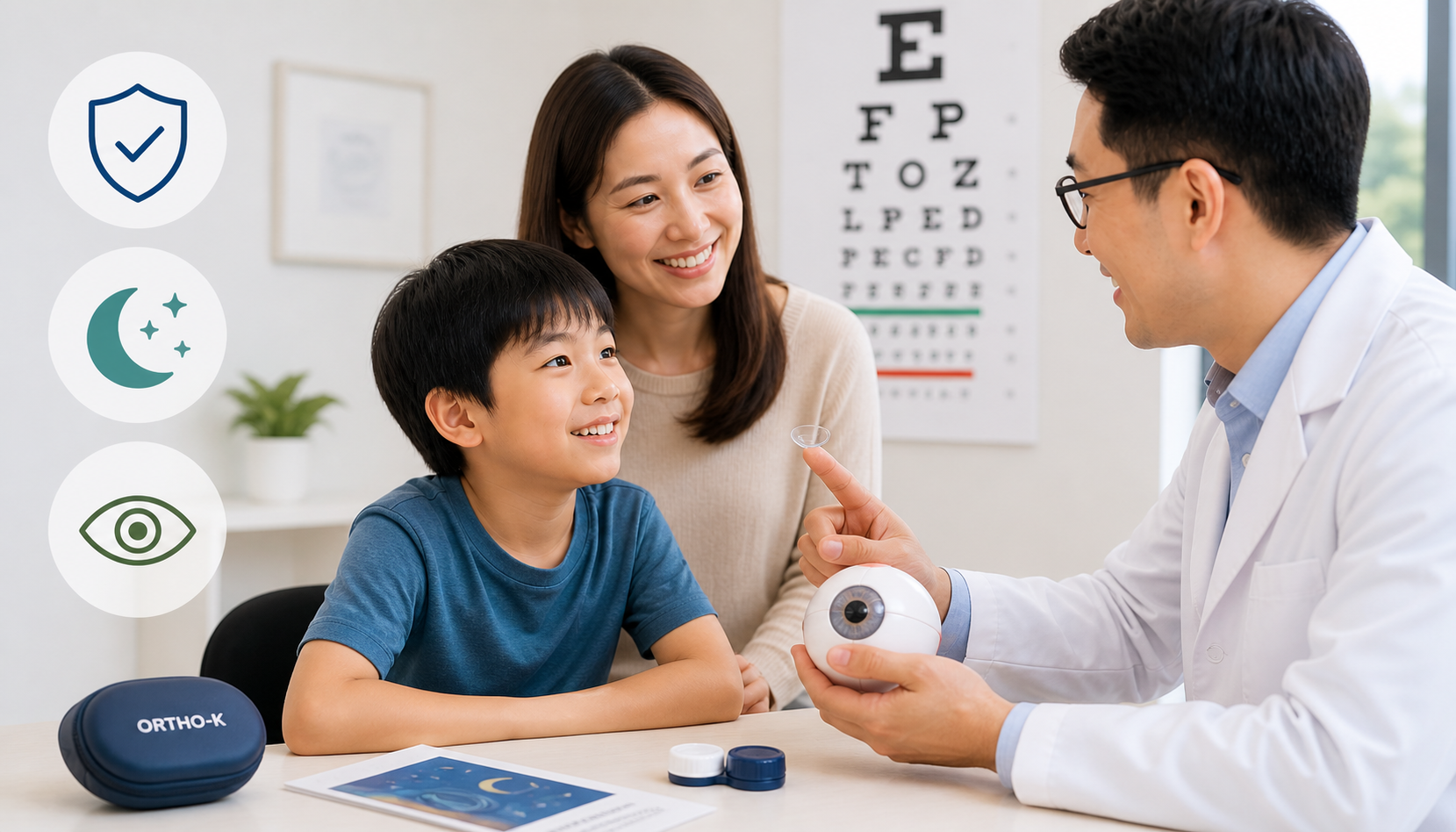
Is Ortho-K Safe for Kids? What Parents Need to Know

Dr. Jason Huang
·8 min read
When I explain ortho-k to parents for the first time, the reaction is almost always the same. They like the idea. They understand the benefit of slowing their child's myopia progression while also correcting their vision. And then they get to the part about sleeping in contact lenses, and their face changes.
"Is that safe?"
It's a fair question. I'd ask it too. The idea of a child sleeping in a contact lens goes against what most parents have heard about lens wear. So let me walk through what the research actually says, what the real risks are, and how they compare to the alternatives.
These are not regular contact lenses
The first thing to understand is that ortho-k lenses are a completely different category from the soft contact lenses most people are familiar with. Ortho-k lenses are rigid, gas-permeable lenses made from materials specifically designed to allow high levels of oxygen to reach the cornea during overnight wear.
Soft contact lenses are generally not meant to be slept in. When you sleep in a soft lens, it traps bacteria in the contact lens against the eye and also significantly reduces oxygen flow to the cornea, creating an environment where bacteria can thrive. That's why every eye doctor tells you not to sleep in your contacts.
Ortho-k lenses are different by design. The rigid material doesn't absorb water the way soft lenses do, and the gas-permeable structure allows oxygen to pass around the lens to the cornea even while the eyelid is closed. They went through FDA approval specifically for overnight wear.
What the infection data actually shows
The concern most parents have is infection — specifically microbial keratitis, which is a bacterial or microbial infection of the cornea. It's the most serious potential complication of any contact lens wear, and it's the one worth talking about directly.
A large multicenter study in Russia(opens in new tab) published in Eye & Contact Lens estimated the incidence of microbial keratitis in children wearing ortho-k at approximately 5.3 per 10,000 patient-years. To put that in context:
Lens type | Microbial keratitis rate (per 10,000 patient-years) |
Ortho-k (children) | ~5 |
Daily-wear soft contact lenses | 2–4 |
Extended-wear soft contact lenses | 13–21 |
Ortho-k infection rates are in the same general range as daily-wear soft lenses and well below extended-wear soft lenses. This is based on published epidemiological data(opens in new tab) comparing contact lens types.
Does this mean ortho-k is risk-free? No. Any contact lens carries some infection risk. But the data does not support the idea that ortho-k is unusually dangerous compared to other types of lens wear. The risk is real, it's quantified, and it's manageable with proper care.
The most common side effects (and why most are minor)
An 18-year follow-up study(opens in new tab) published in Contact Lens and Anterior Eye followed 300 patients (both children and adults) and found the following:
65.7% of children had no complications at all over their entire course of ortho-k wear
The most common issue was corneal staining — a minor surface irritation detectable under examination but rarely felt by the patient
Zero cases of microbial keratitis occurred in the children in this study (one case occurred in the adult group, at a rate of 6.8 per 10,000 patient-years)
All corneal changes were temporary and reversible upon discontinuation
A systematic review published in 2024(opens in new tab) in International Ophthalmology that pooled data across 45 studies found no cases of microbial keratitis in the interventional study populations, though the authors noted that most individual studies were too small to detect rare events. Corneal staining was reported across multiple studies but described as "relatively benign and reversible."
The pattern across the research is consistent: most children who wear ortho-k don't experience complications. When side effects do occur, they're typically minor and resolve with a lens adjustment or a short break from wear.
Long-term corneal safety
Parents also ask about what years of ortho-k wear might do to the cornea itself. This is a reasonable concern — your child might wear these lenses for five, eight, or even ten years during the period when myopia progression is most active.
The reshaping that ortho-k produces happens in the epithelium, which is the outermost layer of the cornea and one that naturally regenerates. The lens does not cut, burn, or permanently alter any corneal tissue. If your child stops wearing ortho-k for any reason, the cornea returns to its original shape within a few days. There is no permanent structural change.
A long-term clinical outcomes study(opens in new tab) published in Eye & Contact Lens followed 296 patients (154 of them children age 12 and under) for over four years and found no permanent vision loss or irreversible corneal changes. Both children and adults achieved approximately 20/20 unaided daytime vision, and only three adverse events were recorded across 507 total patient-years.
The 18-year study mentioned earlier came to the same conclusion: ortho-k is "a safe and predictable long-term procedure in children and adults, with a low incidence of serious adverse effects."
What actually drives the infection risk
When microbial keratitis does occur with ortho-k, the cause almost always traces back to one thing: hygiene. Specifically:
Not washing hands before handling lenses
Using tap water instead of the recommended cleaning solution
Not replacing the lens case regularly
Skipping the cleaning step and reinserting a lens that wasn't properly disinfected
Swimming or showering while wearing the lenses (water exposure introduces microorganisms)
These are the same risk factors that drive infection in any type of contact lens wear. The lens itself is not inherently dangerous. The handling is where risk enters the picture.
This is why the parent's role matters. A child who is responsible enough to follow the nightly routine — wash hands, clean the lens, store it properly, use the right solution — is a child for whom ortho-k can be very safe. A child who is going to cut corners on hygiene is a child who isn't ready yet, regardless of their prescription.
In our practice, we walk every family through the lens care process in detail and make sure both the child and the parent are comfortable with the routine before we dispense lenses.
How we monitor safety
Ortho-k isn't a "fit it and forget it" process. Regular follow-up visits are part of the program, particularly in the first few weeks when the fit is being optimized. After that, patients come in for scheduled check-ups where we evaluate:
Corneal health (looking for any staining, irritation, or changes)
Lens fit and centration (making sure the lens is still positioned correctly)
Visual acuity (confirming the correction is holding through the day)
Prescription stability (tracking whether myopia progression is slowing as expected)
If there's any issue — even a minor one like early corneal staining — we catch it early and adjust. That's the value of ongoing monitoring: problems that might become serious if ignored are caught when they're still simple to fix.
Putting the risk in perspective
Every medical decision involves weighing risks against benefits. For ortho-k in children, here's how I think about it:
The infection risk is real but low — comparable to daily-wear soft contacts, which millions of children and teens already wear. The most common side effects are minor and reversible. The long-term data, going back nearly two decades, shows no permanent harm to the cornea.
On the other side, untreated myopia progression carries its own risks. Every additional diopter of myopia increases the lifetime risk of retinal detachment, glaucoma, and myopic macular degeneration(opens in new tab). These are serious, sight-threatening conditions. Slowing progression during childhood, when the eye is growing fastest, is the window of greatest impact.
That doesn't mean ortho-k is right for every child. But the safety profile, when you look at the actual data rather than the initial instinct of "sleeping in lenses sounds scary," is well-established and reassuring.
Questions to ask before starting
If you're considering ortho-k for your child, here are the questions I'd suggest asking at a consultation:
Is my child's prescription within the treatable range for ortho-k?
Is my child mature enough to follow a consistent lens care routine?
What does the follow-up schedule look like?
What should I watch for at home that would warrant an urgent visit?
How will we track whether myopia progression is actually slowing?
For a comparison of ortho-k with other myopia control approaches — including MiSight, atropine, and specialty glasses — read our myopia control options comparison. For cost details, see our myopia control cost breakdown for Ontario.
Book a myopia control assessment
If your child's myopia is progressing and you want to understand whether ortho-k is a good fit, the first step is a myopia control assessment. At Elevate Vision Care, we'll evaluate your child's prescription, corneal shape, and eye health, and walk you through the options — including whether ortho-k, MiSight, or atropine makes the most sense for their situation.
Submit an inquiry(opens in new tab) and our team will be in touch.