Do Blue Light Glasses Work? What the Research Actually Says

Dr. Jason Huang
·10 min read
Blue light glasses have become one of the most heavily marketed items in optometry over the past five years. You've probably seen them in every optical shop and pharmacy chain. The pitch is compelling: your screens emit harmful blue light, and these glasses protect your eyes from the damage.
I don't recommend blue light glasses as a first-line treatment for digital eye strain. Here's why, and what actually helps.
What Are Blue Light Glasses?
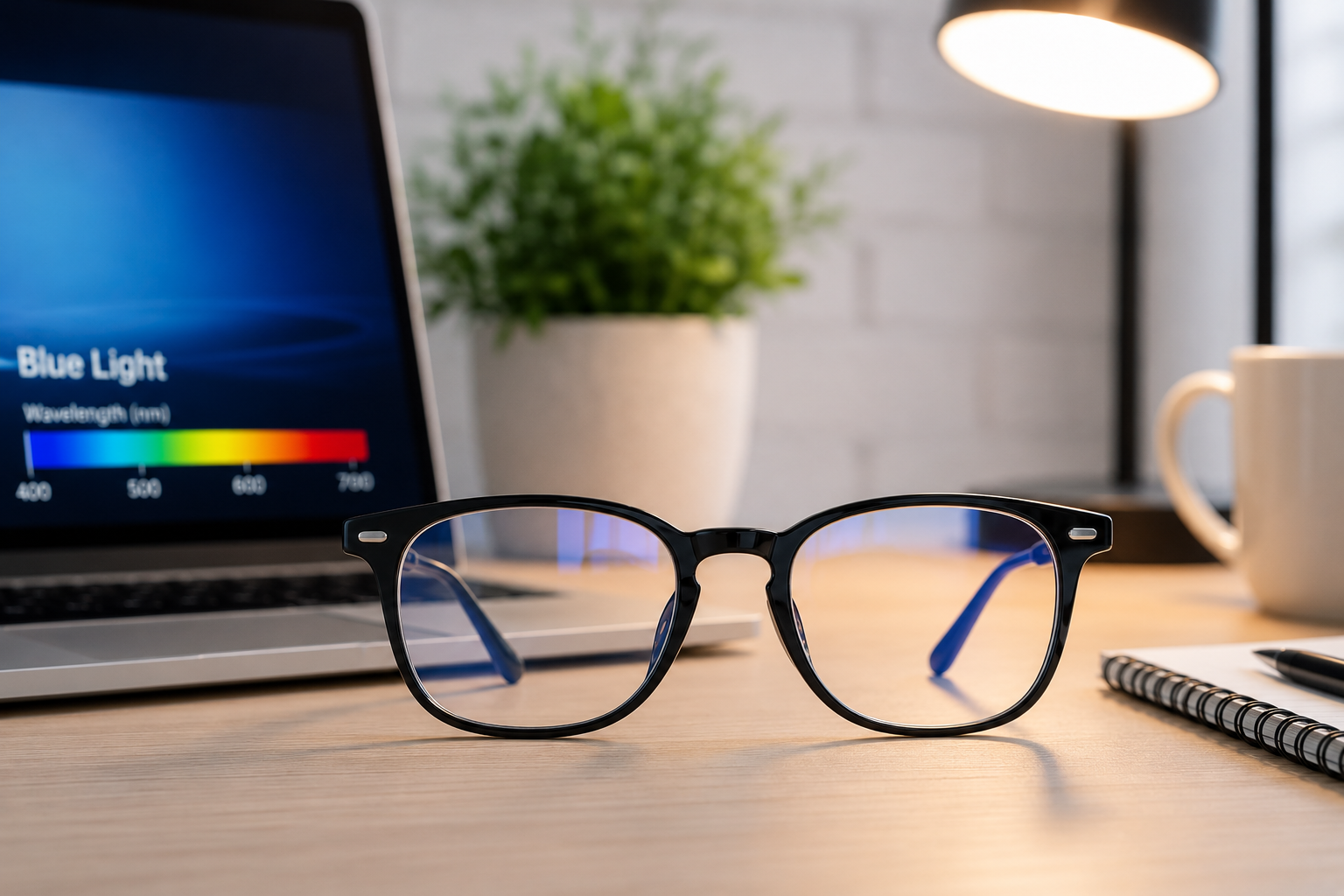
Blue light glasses (also called blue light blocking glasses or computer glasses) are lenses with a special coating or tint designed to filter out a portion of short-wavelength light in the blue spectrum. This artificial blue light comes from LED screens, phones, tablets, and fluorescent lighting.
They typically filter somewhere between 10% and 25% of blue light, depending on the product. Some high-filter versions use an amber or yellow tint and can filter up to 99%.
The claims vary by brand, but most promise some combination of:
Less eye strain and visual fatigue
Fewer headaches
Better sleep
Long-term protection against retinal damage
These are four different claims, and the evidence behind each one is quite different.
What the Research Actually Shows
Eye Strain: The Evidence Is Weak
This is the most common reason people buy blue light glasses, and it's where the evidence is clearest, clearly not supportive.
In 2023, Cochrane, an organization that conducts the gold standard of evidence reviews, published an updated systematic review of 17 randomized controlled trials(opens in new tab) on blue light filtering spectacle lenses. Cochrane reviews are considered some of the most rigorous in medicine because they pool data from multiple independent trials rather than relying on any single study.
The conclusion: blue light filtering glasses “may not attenuate symptoms of eye strain with computer use.” The researchers found “probably little or no effect” on visual acuity, and mixed results for everything else. Their overall finding was that “the current evidence does not support prescribing blue-light filtering lenses to the general population.”
A separate double-masked randomized controlled trial(opens in new tab) put 120 symptomatic computer users in either blue-blocking lenses or clear placebo lenses for a two-hour computer task. No significant difference in eye strain symptoms. No difference on objective measures of eye fatigue. The glasses, even when patients expected them to help, made no measurable difference.
The American Academy of Ophthalmology is equally direct. Their position is that “the Academy does not recommend any special eyewear for computer use”(opens in new tab) and that “there is no scientific evidence that the light coming from computer screens is damaging to the eyes.”
So Why Do So Many People Feel Better in Them?
This is worth taking seriously, because patients tell me all the time that blue light glasses helped them. I don't dismiss that.
But there are a few explanations that don't require the glasses themselves to be doing anything. Buying glasses often comes with a reminder to take breaks from screens. Paying attention to screen habits changes screen habits. There's also a well-documented placebo effect with wearable interventions; the double-masked RCT above was specifically designed to control for this, and still found no benefit beyond placebo.
There's also this: if blue light glasses come with an updated or corrected prescription, the prescription is doing the work.
Retinal Damage: Very Unlikely From Screens
Some marketing implies that screen-emitted blue light may damage the retina over time, similar to UV damage. Researchers have looked at this.
A key point from the Cochrane review: none of the 17 included trials evaluated retinal health. This doesn't mean screens are safe to ignore, but it does mean we have no evidence they're causing retinal damage either.
The AAO makes it plain: the amount of blue light from screens is roughly a thousandth of what you get from natural daylight(opens in new tab). If blue light from screens were damaging your retina, we'd expect an epidemic of screen-related macular degeneration in people who work at computers all day. We aren't seeing that.
Where the Evidence Is Stronger: Sleep
Sleep is the one area where the story is genuinely more nuanced.
The science here is solid at a biological level. A study on blue LED light and melatonin suppression(opens in new tab) showed a clear dose-response relationship: more blue light in the 446–477 nm range leads to more melatonin suppression. Melatonin is the hormone that signals your body to sleep. Suppress it at night, and you delay sleep onset and reduce sleep quality.
A small randomized crossover trial(opens in new tab) had 14 adults with insomnia wear either amber-tinted blue-blocking lenses or clear lenses for two hours before bed for seven nights. The amber lens group showed significantly improved sleep quality, longer total sleep time, and better scores on insomnia rating scales.
So, for people who are genuinely struggling to fall asleep and use screens right before bed, there may be a real benefit to wearing blue-blocking lenses in the hours before sleep. Amber or orange-tinted lenses (which filter significantly more blue light than the lightly tinted lenses typically sold for daytime use) are what the studies used.
That said, the sleep researchers would also tell you that dimming your screen brightness, enabling night mode, and putting your phone down 30–60 minutes before bed achieves the same goal, without buying anything.
What Actually Causes Digital Eye Strain
This matters because digital eye strain is real. Headaches behind the eyes, blurry vision after long screen sessions, dry or irritated eyes, neck tension, these are genuine symptoms that affect a lot of patients. Dismissing the symptom because the solution you've been sold is wrong doesn't help anyone.
Here's what we know causes it:
Reduced blinking. When people focus on screens, blink rate drops from around 15–20 times per minute to as low as 5–7 times per minute. Blinking spreads the tear film across the eye. Less blinking means more evaporation, more dryness, more irritation. This is the single biggest driver of screen-related eye discomfort.
Accommodation fatigue. Your eyes have a focusing muscle (called the ciliary muscle) that contracts to bring near objects into focus, a function called accommodation. Staring at a screen for hours at the same distance keeps that muscle in a sustained state of contraction. It gets tired. That manifests as blurry vision when you look up, or a dull ache behind the eyes.
Undetected vision problems. If you have a small uncorrected prescription, your visual system is working harder than it should to maintain clear vision. A minor focus error that's invisible in daily life becomes exhausting after eight hours at a monitor. I see this regularly, patients who've been told their vision is “fine” but are quietly compensating every time they look at a screen.
Screen distance and angle. Looking at a monitor positioned too close, too high, or with heavy glare forces your eyes and neck into awkward positions. None of this involves blue light.
What Actually Helps
If you're dealing with eye strain from screen use, these are the evidence-based starting points:
The 20-20-20 rule. Every 20 minutes, look at something 20 feet away for 20 seconds. This gives the focusing muscle a break and triggers a full blink. The AAO endorses this as their primary recommendation for digital eye strain. Set a timer. It sounds simple, and it is, but most people don't do it.
Blink deliberately. Remind yourself to blink fully during screen work. Partial blinks (a common habit at screens) don't spread the tear film properly. If your eyes still feel dry, preservative-free artificial tears are safe to use as often as needed.
Get a current prescription. If you haven't had an eye exam in the past two years and you're spending significant time at screens, start there. An outdated prescription is a common and underdiagnosed source of screen fatigue. If you'd like a check on your current coverage, our post on OHIP eye exam coverage in Ontario explains who qualifies for a covered exam.
Check your lens quality. For patients who wear glasses, the quality and type of lenses can make a real difference to visual comfort at screens. Our post on digitally surfaced lenses vs stock lenses covers this in detail, for people with more complex prescriptions or high screen time, there are lens options worth considering that have actual clinical merit.
Treat dry eye if it's there. Dry eye disease is common and often undertreated. If your eyes are gritty, red, or watery at screens, dry eye may be the root cause. That needs a proper assessment, not a gadget.
Screen distance and position. Arm's length from the monitor is a good starting point. The top of the screen should be at or slightly below eye level. Reduce glare from windows or overhead lights.
Who Might Benefit from Blue Light Glasses
I don't want to suggest these glasses are useless for everyone.
People with photosensitivity conditions. Some patients with migraines, traumatic brain injuries, concussions, or certain neurological conditions are genuinely sensitive to light in ways that a typical screen user isn't. For these patients, filtering certain wavelengths can reduce discomfort. This is a clinical situation, though, not a general recommendation.
People with genuine screen-related sleep disruption. If you regularly use screens within an hour or two of bedtime and struggle to fall asleep, amber-tinted glasses in the evening may help. The biology supports it. But this is a specific use case with specific timing requirements, not all-day computer glasses.
As an add-on to a corrective prescription. There is nothing harmful about adding a blue light coating to glasses you were already going to buy. If you want it for peace of mind and it doesn't cost much, that's a reasonable personal choice. Just don't expect it to solve eye strain that a prescription or better screen habits would fix.
The Bottom Line
Blue light glasses are not harmful. Some people find them helpful. But the evidence for the main claim, that they reduce digital eye strain, is weak, and the best research we have points to no meaningful benefit over clear lenses for most people.
Your eye strain is real. Blue light probably isn't causing it.
The things that do help are less marketable: take breaks, blink, get your prescription checked, treat your dry eye if you have it. None of those come in a cute frame at a $60 premium.
See What's Actually Going On
If you're experiencing significant eye strain, headaches, or blurred vision during screen work, the right starting point is a comprehensive eye exam, not a gadget.
An exam can check whether your prescription needs updating, identify any dry eye or focusing issues, and give you a clearer picture of what's driving your symptoms. Book an eye exam(opens in new tab) and our team will be in touch.