ZEISS VISUFIT 1000: 3D Glasses Measurement in Markham
Your prescription tells the lab how strong your lenses should be. It doesn’t tell them where each lens should sit in front of your eye. That depends on a handful of small fitting measurements, and when they’re off by even a little, new glasses can feel blurry at the edges, tiring to wear, or just not right.
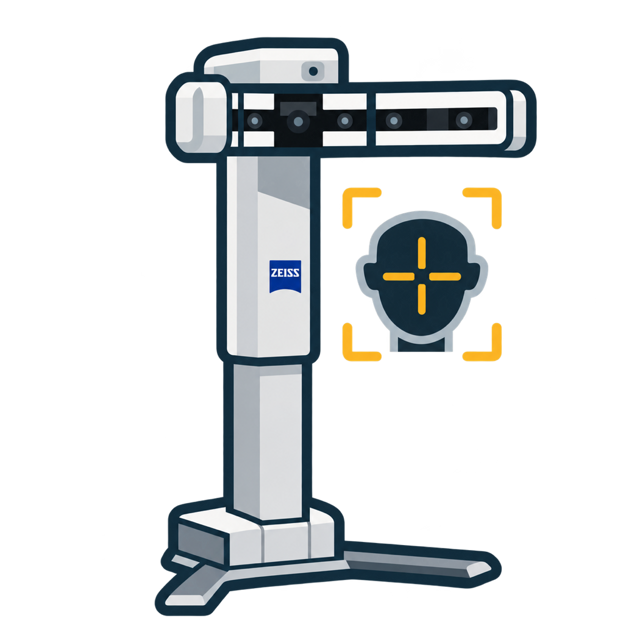
At Elevate Vision Care, we take those measurements with the ZEISS VISUFIT 1000. It captures a 3D image of your face while you wear the frame you’ve chosen, so your lenses are made for the way your glasses actually sit, not an average face.
What the VISUFIT 1000 Measures
One scan gives us every number the lab needs to position your lenses, with your new frame on your face.
The distance between the centres of your pupils, measured for each eye separately. Most faces aren’t perfectly symmetrical, so each lens is centred on its own eye.
How high your pupil sits in the frame. For progressive lenses, this decides where the distance, middle and reading zones go.
The gap between the back of the lens and your eye. It changes how strong the lens acts, which matters more the stronger your prescription is.
How far the frame front tips toward your cheeks. Individualized lenses can be designed around your real angle instead of a standard one.
Why Precise Fitting Measurements Matter
A lens works best at its optical centre. When that centre doesn’t line up with your pupil, your eyes have to work harder to compensate. With a mild prescription you may never notice. With a strong prescription, the same small error can cause eye strain, headaches or a pulling feeling.
Traditional tools have limits here. A study comparing several measuring methods found that PD was repeatable with all of them, but fitting height and pantoscopic tilt were much less consistent, enough to cause centring errors in free-form progressive lenses. In a randomized trial of 95 experienced progressive wearers, people preferred lenses customized with their own vertex distance, fitting height, tilt and wrap, and had a wider area of clear vision when reading.
Progressive lenses are the least forgiving, because the clear zones are joined by a narrow corridor that has to line up with where your eyes naturally look. Our comparison of progressive lenses vs. bifocals explains how those zones work.
How the VISUFIT 1000 Gets It Right
According to ZEISS, nine calibrated cameras capture a 180° view of your face in a single shot, with no clip-on measuring device and no hand-drawn marks on your lenses.
A laser speckle target keeps your eyes looking into the distance, so they don’t turn inward and skew your PD.
A posture assistant flags head or body tilt that would throw off the measurements, before the scan is taken.
A monocular mode measures each eye on its own, which helps people who have trouble keeping both eyes on a target.
You can view yourself from every angle and compare frames side by side, which makes choosing a shape much easier.
What to Expect
- Choose your frame with our optical team. The measurement is taken with the frame you’re actually buying.
- Stand in front of the VISUFIT 1000 and look at the target. The scan itself takes a moment, with nothing touching your face.
- We review the 3D image with you, check your posture and the frame position, and confirm your measurements.
- Your measurements go to the lab with your prescription, so your lenses are made for how your glasses sit on you.
Need an updated prescription first? We can do your comprehensive eye exam and your VISUFIT measurement in the same visit.
Who Benefits Most
Everyone getting new glasses is measured the same way, but precision matters most if you:
- are getting progressive lenses for the first time
- have a strong prescription or significant astigmatism
- are ordering individualized or free-form lenses
- have had glasses that never felt right, even with the correct prescription
If a new pair has given you trouble before, our guide to adjusting to new glasses covers what’s normal in the first couple of weeks and when discomfort points to a fitting problem.
Frequently Asked Questions
What is the ZEISS VISUFIT 1000?
The ZEISS VISUFIT 1000 is a 3D measuring system used when ordering glasses. It photographs your face from several angles at once while you wear your chosen frame, then calculates your pupillary distance, fitting height, vertex distance and frame tilt. Those numbers tell the lab exactly where to position each lens.
Where can I get my PD measured?
Pupillary distance is usually measured by an optometrist or optician when you order glasses. Some clinics use a ruler or a handheld pupillometer, while others use a 3D system such as the ZEISS VISUFIT 1000, which also captures fitting height and frame angles. Measuring PD yourself in a mirror or with a phone app tends to be much less reliable.
Is it normal for new glasses to be blurry?
A short adjustment period is normal, especially with a big prescription change or your first progressive lenses, and it usually settles within a week or two. Blur that stays the same, blur only in one eye, or headaches that don’t improve can point to a prescription or fitting problem, such as lenses that aren’t centred on your pupils. Your eye care provider can check both.
Why are my progressive lenses not working?
The most common reasons are a fitting height or pupillary distance that doesn’t match where your eyes look through the frame, a frame that has shifted or sits differently than when you were measured, or a prescription that needs updating. Progressive lenses have narrow clear zones, so small measurement errors are easy to notice. A re-check of the fit and measurements often solves the problem.
What is fitting height in glasses?
Fitting height is the vertical distance from the bottom of the lens opening in your frame to the centre of your pupil. It matters most for progressive and bifocal lenses, because it determines where the distance and reading areas are placed. It has to be measured with the actual frame you’re buying, adjusted to sit the way you’ll wear it.
How long does it take to get used to progressive lenses?
Most people adjust to progressive lenses within a few days to two weeks of wearing them full time. Learning to point your nose at what you want to see, rather than moving only your eyes, helps. If reading or distance vision still feels like a struggle after two weeks, the fit and measurements should be checked.
Get Measured for Your Next Pair
A VISUFIT measurement takes just a few minutes when you choose new frames, and it shapes how your lenses perform for years. Book an eye exam at our Markham clinic and we’ll take care of your prescription and your fit.
Book an Eye Exam