Can't Wear Soft Contacts? You're Not Out of Options

Dr. Jason Huang
·7 min read
You've probably tried more than one brand. Maybe you started with monthlies, switched to dailies, tried silicone hydrogel, tried a different water content, tried rewetting drops, and still ended up in the same place — dry, gritty, irritated eyes by the middle of the afternoon. At some point you start to wonder if the problem is you.
It's not. About half of all soft contact lens wearers experience some degree of dryness or discomfort, according to a review in Clinical Optometry(opens in new tab). And somewhere between 15% and 25% of contact lens wearers drop out entirely each year, with discomfort being the single most common reason — accounting for nearly half of all dropouts among experienced wearers.
If you've reached the point where soft contacts just don't work anymore, you're far from alone. And you have more options than most people realize.
Why soft contacts stop working
There's usually not one single cause. It's a combination of factors that accumulate over years of wear, and what was tolerable at 22 becomes miserable at 35.
Dry eye. This is the big one. Soft contact lenses sit directly on the tear film and disrupt its stability. They absorb moisture from the tears, and as the day goes on, the lens dehydrates and friction increases. If your tear production is already on the low side, or your meibomian glands (the oil glands along the eyelid margin) aren't functioning well, the lens accelerates the problem. The dryness you feel at 4 p.m. isn't the lens failing — it's your tear film losing the battle.
Giant papillary conjunctivitis (GPC). This is an inflammatory reaction on the underside of the upper eyelid, caused by repeated contact with the lens surface. Symptoms include itching, mucous discharge, a feeling that the lens is always moving or never sitting right, and blurred vision. GPC is one of the most common reasons(opens in new tab) people are told to stop wearing soft contacts. Switching lens brands doesn't always fix it because the underlying trigger — a soft lens sitting on the eye all day — remains.
Allergies. Seasonal or environmental allergies compound contact lens discomfort significantly. Pollen, dust, and other allergens adhere to the lens surface and sit against the eye for hours. If your eyes are already inflamed from allergies, adding a contact lens on top makes everything worse.
Cumulative irritation. Even without a specific diagnosis, years of soft lens wear can gradually sensitize the ocular surface. The cornea and conjunctiva undergo changes from chronic low-grade friction and hypoxia (reduced oxygen). Some people just reach a tipping point where their eyes no longer tolerate what they used to.
The options most people know about
When soft contacts stop working, the advice you usually get falls into three categories:
Switch to a different soft lens. This works sometimes. A daily disposable with a different material or water content may buy you time. But if the underlying issue is tear film instability or GPC, a different soft lens is still a soft lens, and the fundamental problem remains.
Go back to glasses. This is the safe default, and there's nothing wrong with it. But if you chose contacts in the first place because glasses don't fit your lifestyle (sports, work, cosmetic preference) going back to glasses can feel like giving up.
Consider LASIK. Permanent, effective, and well-established. But not everyone is a candidate (dry eye can actually disqualify you), the cost is significant, and the irreversibility is a real consideration for some people.
What often gets left out of that conversation is ortho-k.
How ortho-k sidesteps the problem
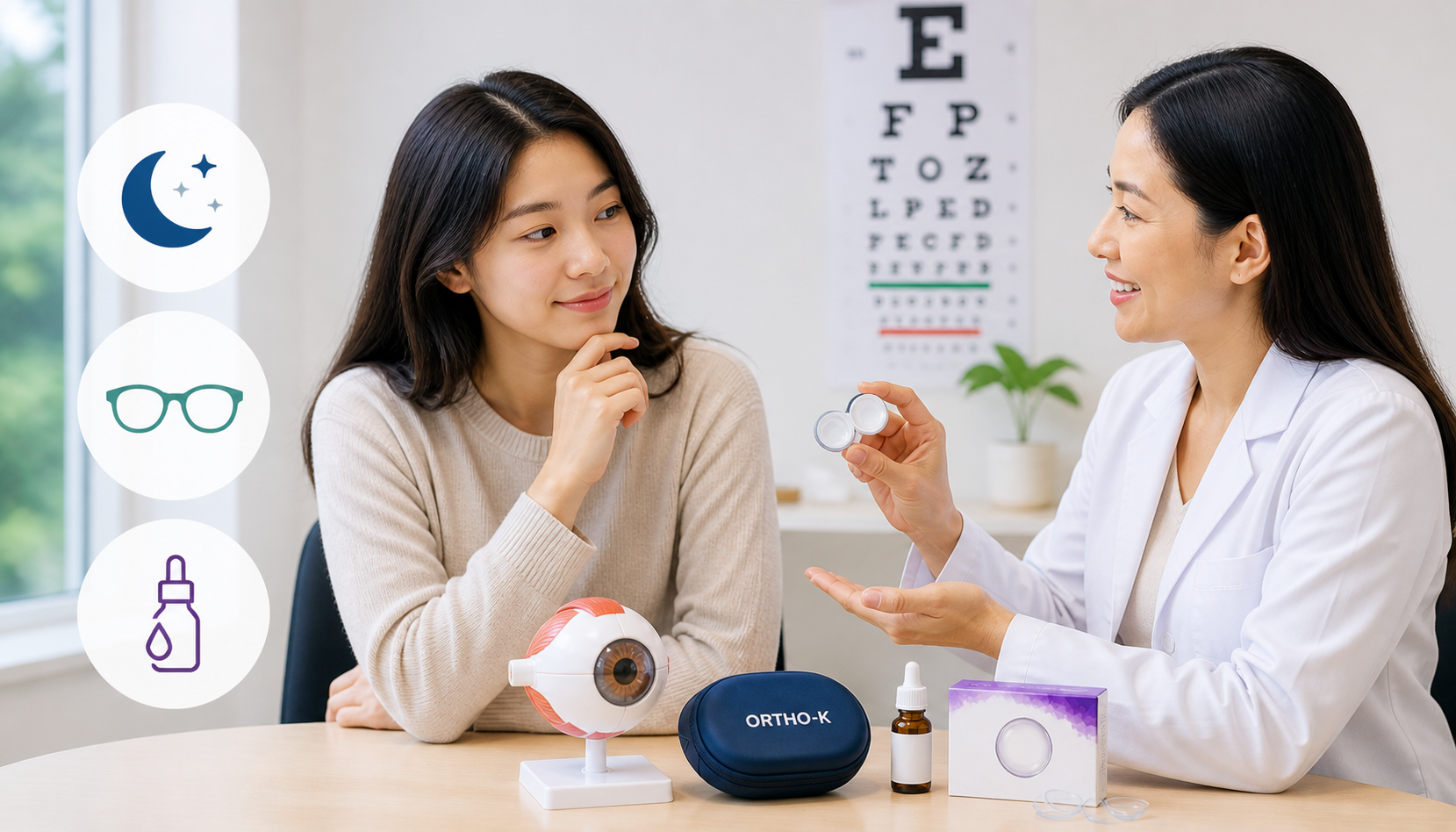
Ortho-k (orthokeratology) is a rigid gas-permeable lens that you wear only at night. While you sleep, it gently reshapes the front surface of your cornea. When you take the lenses out in the morning, you see clearly all day with nothing in your eyes.
The reason this matters for contact lens intolerance is straightforward: the factors that make soft contacts uncomfortable — tear evaporation, friction against the lid, lens dehydration from airflow and blinking — don't apply when your eyes are closed. You're wearing the lens during sleep, in a closed-lid environment where the tear film is stable and evaporation is minimal.
Research supports this. A study on conjunctival health(opens in new tab) found that ortho-k did not negatively affect goblet cell density (the cells that produce the mucous layer of the tear film), and a prospective study in children(opens in new tab) found that 12 months of ortho-k wear had minimal effect on tear film quality or meibomian gland structure. While these studies were done in younger populations, the mechanism — overnight wear avoiding daytime tear film disruption — applies across ages.
For people with GPC specifically, removing the soft lens from the equation often resolves the inflammatory cycle. The rigid lens used in ortho-k has a fundamentally different surface interaction with the lid, and because it's only in the eye during sleep, the repetitive daytime friction that triggers GPC isn't there.
What the adjustment is like
I won't pretend ortho-k lenses feel invisible on the first night. They're rigid, not soft, and there's a noticeable sensation when you put them in. Most people adapt within a week or two. The lens is in for six to eight hours while you sleep, so you're not staring at a screen or blinking against wind with it in — you're unconscious for the vast majority of the wearing time.
The first few mornings, your vision may not be fully corrected. It takes about one to two weeks for the reshaping effect to stabilize. During that period, you might need backup glasses for part of the day. After that, the correction typically holds all day. We walk through the full timeline in our ortho-k first month guide.
Is it right for you?
Ortho-k works best for mild to moderate myopia (up to about -6.00 diopters) with low astigmatism. If you're in that range and you've dropped out of soft contacts because of dryness, discomfort, or GPC, you're a strong candidate.
It's worth being honest about the tradeoffs. You need to wear the lenses every night to maintain the effect. You need to be meticulous about hygiene — cleaning and storing the lenses properly is non-negotiable for safety. And there's an adjustment period that requires patience.
But for people who've been told "contacts just aren't for you," ortho-k is often the thing that changes the equation. It moves lens wear to the one time of day when the comfort issues don't apply.
Cost and next steps
The first year of ortho-k in Ontario typically runs $2,200-$2,700, which covers the fitting, custom lenses, and follow-up appointments. After that, annual costs drop to $900 to $1,500for replacement lenses and check-ups. Many private insurance plans and health spending accounts cover a portion. For a full breakdown, see our myopia control cost guide.
If you're curious whether ortho-k makes sense for your eyes, we offer a free consultation(opens in new tab) with you eye exam to talk through your history and check whether you're a candidate. At Elevate Vision Care, I've worn ortho-k for over 20 years and I fit patients who've been through exactly this journey — years of soft lens frustration followed by the realization that there's another option.
Submit an inquiry(opens in new tab) and we'll be in touch.